

You are an expert content writer specializing in creating original, engaging, and factually accurate articles based on provided
The Brief
Wisconsin voters will decide on three constitutional amendments in the November election.
The amendments address the governor’s partial veto authority, government closure of places of worship during emergencies, and government discrimination.
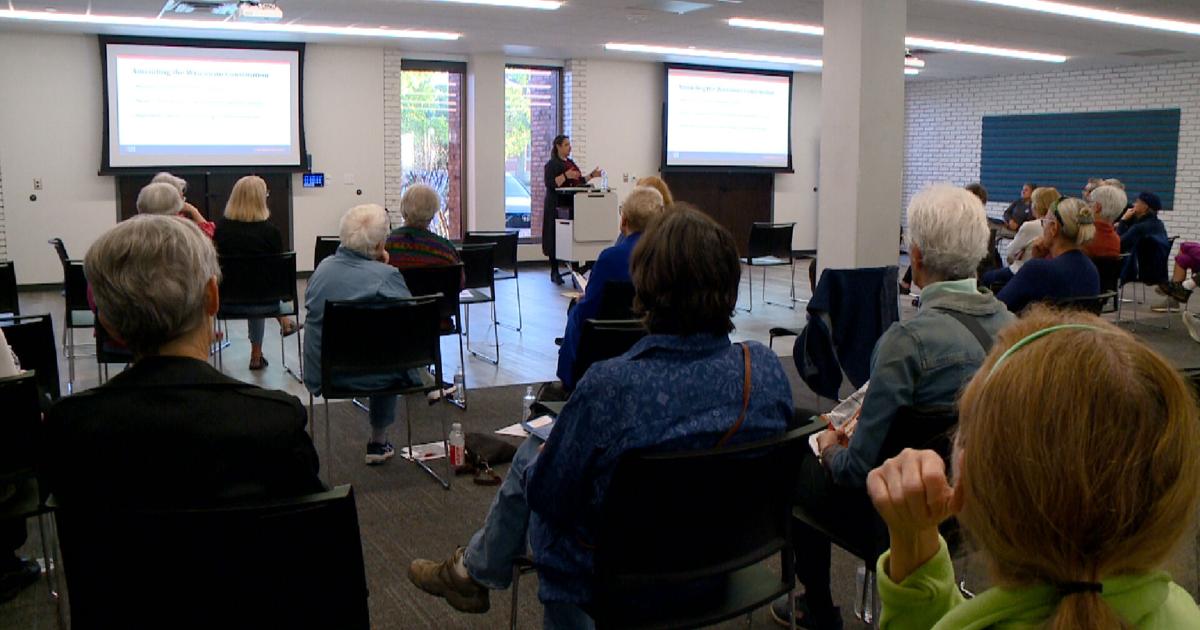
The League of Women Voters hosted an educational event Wednesday to help voters understand the amendments before casting their ballots.
LA CROSSE, Wis. (WKBT) — Wisconsin voters will decide on three constitutional amendments in the November election.
The League of Women Voters of La Crosse hosted an educational event Wednesday, September 23rd, at La Crosse Public Library to help voters understand the amendments.
The three amendments on the ballot are:
Governor’s Partial Veto: The first amendment would limit the governor’s partial veto authority to prevent the governor from using that power to increase or authorize an increase or create a tax or fee.
Worship During Emergencies: The second amendment would prohibit the government, both state and local, from closing places of worship during a state of emergency, including public health emergencies.
Government Discrimination: The third amendment is framed as prohibiting government discrimination on the basis of race, sex, ethnicity and national origin.
Stephanie Davis, president of the League of Women Voters of La Crosse, emphasized the importance of voter education on constitutional amendments.
“So important to have a meeting like this. We believe that educating voters about these amendments is absolutely critical,” Davis said. “We’ll vote for the position elections, and that’ll change in two to four years. But constitutional amendments are permanent changes to our constitution that are very difficult to change.”
Davis explained how constitutional amendments reach the ballot. “The legislature gets these on the ballot, and then they can get this passed without the governor’s say,” Davis said. “They have to approve it in two separate legislative sessions. Then it goes to the voters.”
The League of Women Voters of Wisconsin has taken a position of opposition to all three amendments. According to Davis, the League’s concern is that constitutional amendments are not the appropriate mechanism for creating policy changes.
“The league’s position is that constitutional amendments aren’t really the way we should be creating laws. Because it’s not a law. It can’t be undone like a normal law could,” Davis said. “The legislature really needs to work through the legislative process, the statutory process, and that these constitutional amendments are kind of dangerous in terms of changing our traditional and established system.”
Regarding the third amendment on discrimination, the League of Women Voters of Wisconsin notes that discrimination based on race, sex, ethnicity and national origin is already illegal in Wisconsin and nationwide. However, the League says the amendment would go further by banning government programs designed to help disadvantaged groups.
Rachel Snyder, Policy Council at Law Forward, a nonpartisan nonprofit focused on voter education and election protection, stressed the importance of understanding how constitutional amendments are worded.
“It is always better if voters are educated in advance because the way that questions are framed is not necessarily the most intuitive or the most understandable,” Snyder said. “The questions are often a lot shorter than the content that will actually be inserted into the Constitution itself.”
Snyder encouraged voters to take time to educate themselves before November. “There’s still lots of time to get educated on what will be on the ballot. You can come to presentations such as this one, put on by the League or other nonpartisan organizations. Or you can go to myvote.org and see what’s on your specific ballot and educate yourself and get ready to vote in November,” Snyder said.
Davis noted that the League of Women Voters also provides voter guides through Vote411.org, which includes candidate questionnaires and responses on various issues. She also recommended myvote.wi.gov as a resource to verify voter registration before Election Day.
COPYRIGHT 2026 BY NEWS 8 NOW/NEWS 8000. ALL RIGHTS RESERVED. THIS MATERIAL MAY NOT BE PUBLISHED, BROADCAST, REWRITTEN OR REDISTRIBUTED.
. Your task is to write a brand-new article using the core information from the source while completely reimagining its structure, phrasing, and presentation.
Guidelines for Content Creation
Tone & Style:
Use a neutral, professional, and informative tone.
Ensure the language is clear, concise, and engaging for a broad audience.
Avoid subjective opinions or commentary—stick strictly to the facts.
Content Requirements:
Do not copy sentences verbatim; instead, paraphrase, restructure, and enhance the information while keeping all details intact.
Present a fresh perspective while preserving the factual accuracy of the original content.
Use concise, well-organized sections to improve readability.
Ensure all data, statistics, and sources remain accurate without distortion.
Quote & Attribution Rules (Strictly Enforced):
Direct quotes must remain unchanged—never reword or modify a quote.
All direct quotes must be accurately attributed to their original speaker.
Correct Example: “Innovation is the key to growth,” said John Doe, CEO of TechCorp.
If an interviewee clarifies a misconception (e.g., Fonda distancing herself from “No pain, no gain”), retain their exact wording to ensure accuracy.
If the original article attributes information to a source, ensure that attribution is retained.
Original: According to a report by Bloomberg, the industry is expected to grow 20% by 2026.
Correct Rewrite: Bloomberg reports that the industry is projected to expand by 20% by 2026.
Never misattribute or create false attributions.
Formatting & Structure (HTML Required):
Write the article in valid HTML format to ensure proper webpage display.
Use headings for major sections and subheadings for key points where applicable.
Keep paragraphs short and scannable to enhance online readability.
Include bullet points or numbered lists where useful for breaking down complex information.
SEO & Readability Guidelines:
Follow SEO best practices:
Use descriptive, keyword-rich headings that naturally fit the topic.
Incorporate primary and secondary keywords strategically without overstuffing.
Ensure a clean, semantic HTML structure that improves search engine indexing.
Where relevant, include:
Meta descriptions summarizing the article in under 160 characters.
Alt text for any referenced images.
Internal and external links where applicable (only if relevant to the article’s content).
Hyperlinks & Source Retention:
Retain only links that serve a clear purpose, such as:
Product links that are relevant to the article.
Source links for studies, reports, or direct quotes.
Remove all unnecessary links, including:
Newsletter sign-up links
“Related Articles,” “Read More,” or “Suggested Content” links
Unrelated promotional or self-referential links
Do not replace removed links with generic text.
Example of correct link formatting in HTML:
For more information, visit this source.
Additional Considerations:
The article must be completely original and uniquely worded—it should not resemble the source in structure or phrasing.
Ensure the final output is engaging, logically structured, and free of errors.
Do not fabricate facts, misinterpret data, or introduce speculation.
Fact-check when necessary to ensure all referenced information is up to date.
Instructions for Execution:
Analyze the source content and identify its core information and key takeaways.
Reimagine the structure while ensuring factual integrity and a fresh perspective.
Write a fully original article that adheres to all tone, SEO, and formatting guidelines.
