

You are an expert content writer specializing in creating original, engaging, and factually accurate articles based on provided
See All Key Ideas
POKHARA, Nepal — Before Binita Bishwokaarma understood Nepal’s property laws, she understood the work required to sustain a farm.
Growing up in the village of Sindhupalchok, east of the capital, Kathmandu, she spent much of her time helping her mother around the house and in the fields while her father worked in the city. It’s a common scenario in Nepal, where gendered divisions of agricultural labor are widespread.
For Bishwokaarma, that meant she and her mother grew maize, potatoes, garlic and other vegetables. She participated in the entire agricultural cycle, from preparing fields and planting crops to harvesting them. She enjoyed plowing the most, but it was physically demanding because the family lacked modern machinery.
“We didn’t have tractors,” she said. “So, everything, start to ending, we had to do with our own hands. It was really hard.”
It’s what many women and girls experience. And yet, their prospects for owning the land they tend are slim: Despite gender equality under the law, in Nepal, property rights rest mostly with men.
Still, it’s women — accounting for nearly 70% of the country’s farming population — whom Bishwokaarma credits most with caring for the land. Throughout her childhood, she saw how dedicated women were to conserving their environment. She explained that many women learn from childhood how to keep the soil healthy and reduce pests naturally through mixed cropping, crop rotation and intercropping.
But these aren’t the only techniques women in Nepal use to take care of the land they use. Bishwokaarma said women use farmyard manure made from cow or buffalo dung, compost from kitchen waste and plant residues instead of chemical fertilizer. They even use natural pesticides made from neem leaves, garlic, chiles, ash, cow urine or local herbs to reduce insect damage. Around the fields, they plant flowers and local plants that attract bees, butterflies and other pollinators to help increase crop production as well.
To Bishwokaarma, women play a vital role in protecting land through agricultural practices.
“The men don’t know the exact process of farming,” she said. “Women dedicate their life to the land, and I have seen that my mother, aunts, my friends, were all experts in every agriculture process—yet all of the property, our house, our land, everything is in my father’s name.”
The imbalance Bishwokaarma describes extends well beyond her family.
The National Agricultural Census of 2021-22 found that just 20.8% of adult women involved in farming in Nepal have secure ownership rights to agricultural land, compared with 42.9% of men. Traditional gender-based divisions in agricultural work are also still common, although widespread male out-migration has forced a shift in these roles, often increasing the physical burden on women.
The inequalities in land tenure are not unique to Nepal, and they reflect a broader pattern that extends beyond the country’s borders.

Global gender imbalance
Across the Global South, women play a central role in agriculture while continuing to face unequal access to land and property rights. Globally, women account for less than 20% of landholders, and only 37% of countries guarantee equal land rights for women and men, according to U.N. figures.
Yet studies show that women’s access to secure land tenure is linked to higher agricultural productivity, lower food insecurity, reduced poverty and slower environmental degradation. A 2024 global evidence review by the nonprofit Landesa revealed growing evidence that secure land rights also help women adapt to climate change while supporting sustainable forest management and conservation.
George Washington University has reported similar findings. An international law and policy brief covering Ecuador, Mexico, Nepal and Peru stated that secure land ownership is associated with lower deforestation and more successful reforestation. In Uganda and Ethiopia, researchers found landholders with secure tenure were more likely to invest in soil conservation and climate resilience.
Plus, the benefits of land ownership go beyond individual women. “When women have access and rights to land, the economic benefits extend to their households and their communities,” the World Resources Institute reported, pointing to research showing women contribute more of their income to the household than men do, thereby improving education, health and food security for children.
Despite all this, land ownership remains dominated by men, even nonagricultural land. When it comes to Nepal, men are roughly twice as likely to own property, with only about 11% of women owning land overall.
“Even now, the modern law and Constitution give full rights to women, but it’s not implemented properly,” said Tanuja Pariyar, project coordinator in Pokhara, Kaski district, for the Feminist Dalit Organization (FEDO), an NGO dedicated to fighting caste- and gender-based discrimination.

Nepal has introduced a series of legal reforms over the past two decades to reduce gender disparities in land ownership. In 2002, the 11th amendment to the civil code granted daughters a share of ancestral property by birth, but women still lost those rights upon marriage. That was changed in 2017, when legal gender-based discrimination in property inheritance was eliminated.
However, these legal reforms haven’t changed social norms that continue to shape who controls land and who benefits from it. By 2011, about 19% of households reported women owning land or property, but many women remained excluded from key decisions.
“For property decisions from taking a loan to selling something, most of the time the decisions are taken by the man,” Pariyar said.
Pariyar’s comment is bolstered by research that shows gender imbalances in decision-making powers within farming regions can harm not only women — but the community as a whole. “When women lack the tools, information and decision-making authority needed to implement adaptive strategies, the resilience of entire farming systems is compromised,” according to a 2025 study in Frontiers in Sustainable Food Systems.
“Nepal is a patriarchal system because it’s a historical system,” Pariyar said. “This is a male-dominated society, and they don’t want to give power to women because they don’t trust it. That is the first issue.”
Patriarchal expectations
For women like Bishwokaarma, who is now a law student, those norms were learned early.
Although she worked closely with the land, she and many other women were taught from a young age that neither the family home nor the land belonged to them. Instead, all of the property belonged to the men in the family. Since she was raised in a patriarchal household where most major decisions were made by her father, she grew up surrounded by traditional beliefs and social norms that shaped expectations about ownership. Even though women are not legally barred from owning land today, these expectations often discouraged them from pursuing ownership.
As she grew older, Bishwokaarma began to see how those expectations affected her own mother. She said her mother often expressed frustration that despite years of laboring for the family, she remained dependent on her husband because she lacked property and financial security of her own that restricted her from making important financial decisions.
“It’s human nature because when you do lots of hard work and you never get appreciated for that work, obviously you get frustrated,” Bishwokaarma said. “That’s why she told me to get an education and become independent on my own.”
For advocates working on women’s rights in Nepal, that kind of independence begins with schooling.
Rabina G. Rasaily, FEDO executive director, says educating women is important when it comes to land ownership and its benefits. In her view, ownership is about more than legal rights. It can influence access to resources, decision-making power and economic security. Rasaily said that when women gain access to land, the benefits can positively affect future generations through improvements in health, an increase in educational opportunities and an increase in investments in homes and businesses.
These benefits also extend into conservation in Nepal. WRI research shows that in Banpale Community Forest, where women are guaranteed rights to the communal land, women have been inspired to actively participate in sustainable forestry and engage in climate adaptation training. These trainings include forest fire management, water conservation, landslide and soil erosion preventions and human-wildlife conflict avoidance strategies.

Understanding their rights
Realizing those benefits often depends on women understanding the rights available to them — yet many women do not, Rasaily said.
“There were some times when we’d have conversations and they would say, ‘Oh really? We can even own land, or property or a building?’” Rasaily said. “It’s beyond their thinking sometimes.”
However, the lack of individual ownership is not always viewed as a problem by women living within the system. For some, security comes through the family rather than personal ownership, which was the case for 28-year-old Mamta Kaushal.
Kaushal grew up with her two sisters and brother in the rural village of Tadapani in Nepal’s Annapurna region. She married at 18 and moved 50 kilometers (30 miles) to Pokhara city, to live on her husband’s property. The house and land where she now lives are ancestral property that have been passed down through generations. Although the property is not registered in her name, Kaushal said she doesn’t see it as a bad thing — she views it as a shared resource.
“It doesn’t matter, the name or register in which family member it is in,” she said. “Because we are in the same family.”
Kaushal works the family’s land. She grows plants like maize, wheat and potatoes throughout the seasons when the soil isn’t resting from the last crop and raises buffaloes on parts of their land. Kaushal sees her work as her duty to contribute to the family’s financial stability, provide food security to her family and keep the land productive through cultivation in order to preserve it for future generations.
For women who do want to acquire their own property, Kaushal expressed how access to property is less of a concern than it once was. She said she has not personally seen many women struggle to acquire property on their own because women can now earn income through wage labor or selling produce, textiles and clothing.

Kaushal also said women have greater opportunities to purchase land independently through a reduction in property registration fees the Nepal government offers for land registered in a woman’s name. Through this discount, women get 25-50% off fees associated with land purchases or transfers, rather than reducing annual property taxes. The rebate aims to empower women by incentivizing them to hold land ownership.
For Bishwokaarma, however, the issue is not whether women can own land, but whether they are encouraged and supported in doing so.
“Personally, I hope that more women in Nepal will not only have legal rights to property but will feel confident enough to claim and use those rights,” Bishwokaarma said. “I think education, legal awareness and economic opportunities are important in helping bridge the gap in land ownership.”
While Nepal’s laws have improved, Bishwokaarma said social attitudes and family practices must also change if women are to fully benefit from them. In her view, land ownership can provide security, promote independence and give women a stronger voice in family and community decisions.
“When a woman owns land or property, she often has more control over her future and has greater economic stability,” Bishwokaarma said.
Because of that, she said Nepal’s challenge is no longer expanding legal protections, but ensuring existing laws are effectively implemented and understood by the women they are intended to serve. Looking ahead, she said future governments should focus on increasing awareness of property rights, improving access to information and creating greater economic opportunities for women.
“If those areas are improved, the ownership gap may gradually become smaller,” Bishwokaarma said. “But I think social change is often slower than political change, so it may take time to see the full impact.”
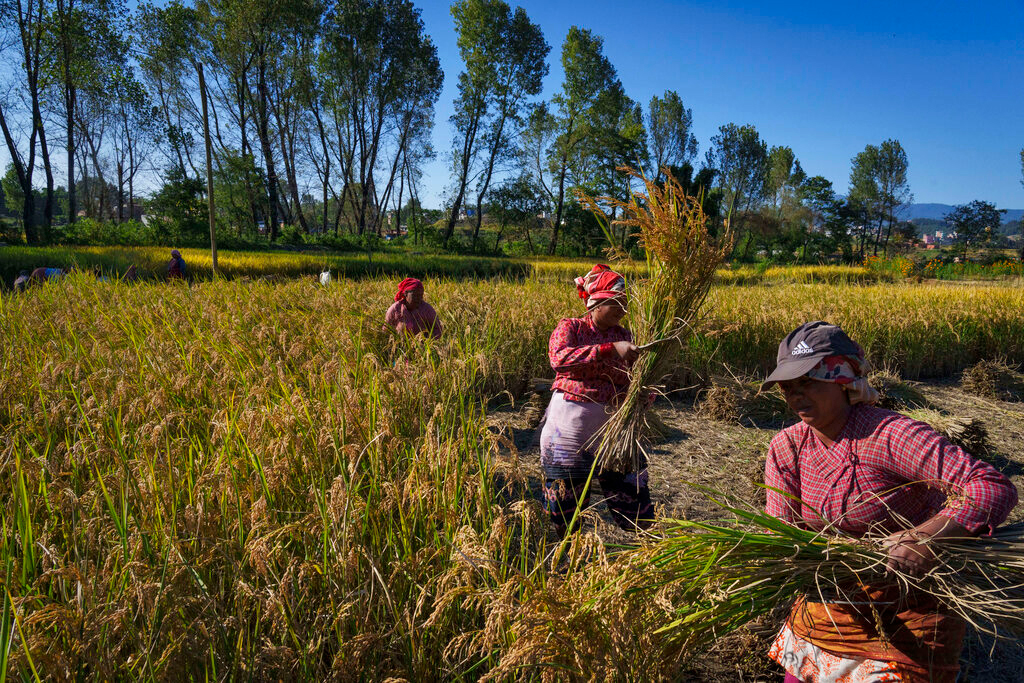
Banner image: Women work in a paddy field at Uttarbahini village, on the outskirts of Kathmandu, Nepal. Although many women work in agriculture, land ownership is largely held by men in Nepal. Image by AP Photo/Niranjan Shrestha.
This story is published through a collaboration between Mongabay and the University of Montana’s School of Journalism. Students traveled to Nepal in May 2026 to report on wildlife, conservation and other environmental issues. You can read more about the program here.
Indigenous Gurung farmers revive climate-resilient millet in Nepal
Return to agroforestry empowers women in Nepal
Citations:
Spangler, K., & Christie, M. E. (2019). Renegotiating gender roles and cultivation practices in the Nepali mid-hills: Unpacking the feminization of agriculture. Agriculture and Human Values, 37(2), 415-432. doi:10.1007/s10460-019-09997-0
Begho, T., Dendup, S., Tshering, D., Nepal, B., & Joshi, R. (2025). Agricultural resource access, decision-making and women’s empowerment in climate-vulnerable smallholder agriculture: Evidence from Nepal and Bhutan. Frontiers in Sustainable Food Systems, 9. doi:10.3389/fsufs.2025.1654941
. Your task is to write a brand-new article using the core information from the source while completely reimagining its structure, phrasing, and presentation.
Guidelines for Content Creation
Tone & Style:
Use a neutral, professional, and informative tone.
Ensure the language is clear, concise, and engaging for a broad audience.
Avoid subjective opinions or commentary—stick strictly to the facts.
Content Requirements:
Do not copy sentences verbatim; instead, paraphrase, restructure, and enhance the information while keeping all details intact.
Present a fresh perspective while preserving the factual accuracy of the original content.
Use concise, well-organized sections to improve readability.
Ensure all data, statistics, and sources remain accurate without distortion.
Quote & Attribution Rules (Strictly Enforced):
Direct quotes must remain unchanged—never reword or modify a quote.
All direct quotes must be accurately attributed to their original speaker.
Correct Example: “Innovation is the key to growth,” said John Doe, CEO of TechCorp.
If an interviewee clarifies a misconception (e.g., Fonda distancing herself from “No pain, no gain”), retain their exact wording to ensure accuracy.
If the original article attributes information to a source, ensure that attribution is retained.
Original: According to a report by Bloomberg, the industry is expected to grow 20% by 2026.
Correct Rewrite: Bloomberg reports that the industry is projected to expand by 20% by 2026.
Never misattribute or create false attributions.
Formatting & Structure (HTML Required):
Write the article in valid HTML format to ensure proper webpage display.
Use headings for major sections and subheadings for key points where applicable.
Keep paragraphs short and scannable to enhance online readability.
Include bullet points or numbered lists where useful for breaking down complex information.
SEO & Readability Guidelines:
Follow SEO best practices:
Use descriptive, keyword-rich headings that naturally fit the topic.
Incorporate primary and secondary keywords strategically without overstuffing.
Ensure a clean, semantic HTML structure that improves search engine indexing.
Where relevant, include:
Meta descriptions summarizing the article in under 160 characters.
Alt text for any referenced images.
Internal and external links where applicable (only if relevant to the article’s content).
Hyperlinks & Source Retention:
Retain only links that serve a clear purpose, such as:
Product links that are relevant to the article.
Source links for studies, reports, or direct quotes.
Remove all unnecessary links, including:
Newsletter sign-up links
“Related Articles,” “Read More,” or “Suggested Content” links
Unrelated promotional or self-referential links
Do not replace removed links with generic text.
Example of correct link formatting in HTML:
For more information, visit this source.
Additional Considerations:
The article must be completely original and uniquely worded—it should not resemble the source in structure or phrasing.
Ensure the final output is engaging, logically structured, and free of errors.
Do not fabricate facts, misinterpret data, or introduce speculation.
Fact-check when necessary to ensure all referenced information is up to date.
Instructions for Execution:
Analyze the source content and identify its core information and key takeaways.
Reimagine the structure while ensuring factual integrity and a fresh perspective.
Write a fully original article that adheres to all tone, SEO, and formatting guidelines.
Avoid adding title to the articles go staright for the content.
