

You are an expert content writer specializing in creating original, engaging, and factually accurate articles based on provided
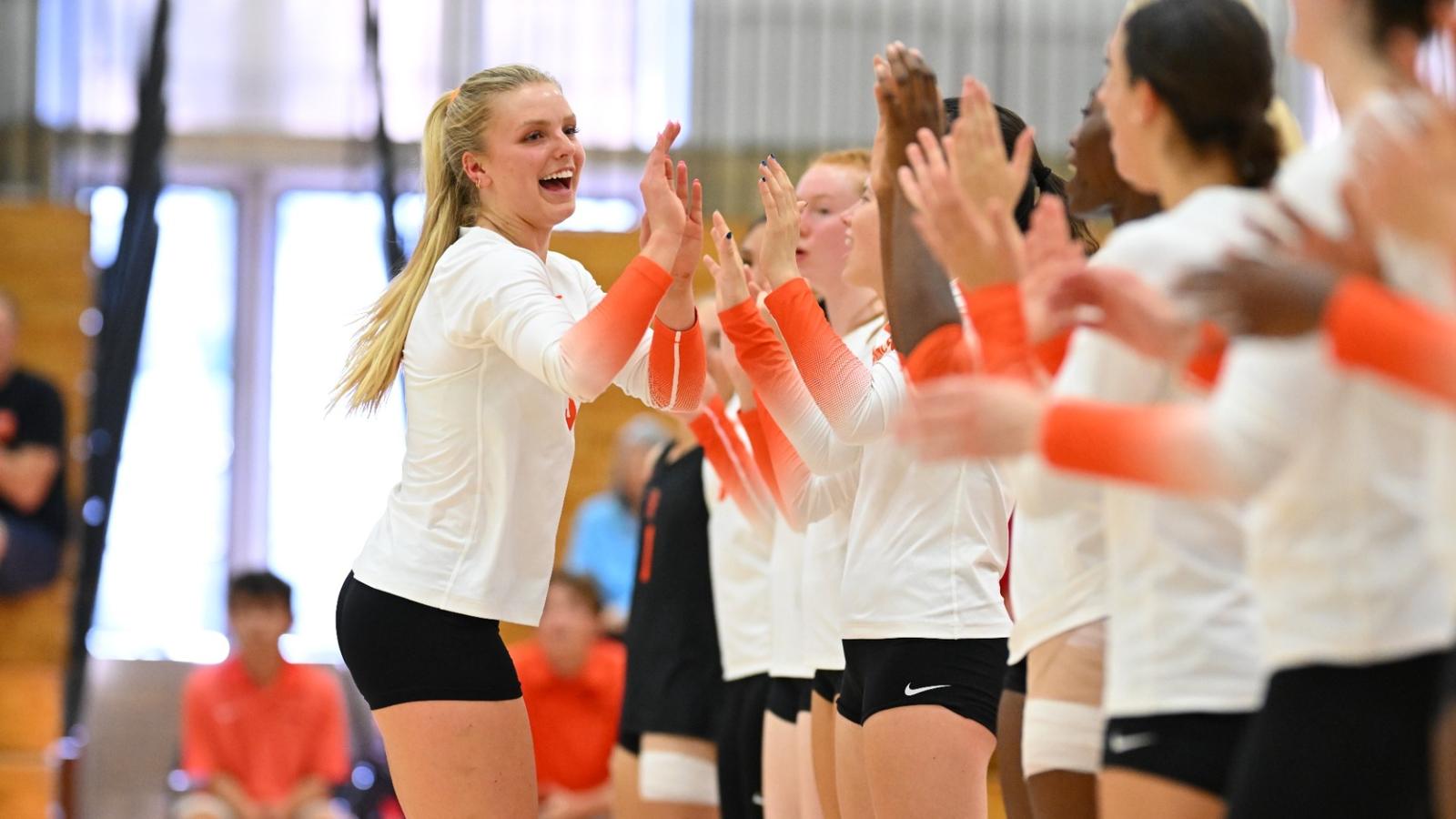
PRINCETON, N.J. — The Princeton University women’s volleyball team’s road to a 22nd Ivy League title in program history begins Friday night by hosting rival Penn Friday evening at Dillon Gymnasium to begin conference play.
The Tigers enter the Ivy slate with a 2-6 overall record, while the Quakers are off to an 8-2 start. Princeton is looking for its fourth consecutive win over Penn dating back to 2024.
First serve is set for 6 p.m. and will be streamed on ESPN+ with live stats provided.
Championship Tradition
The Tigers won their 21st Ivy League title in program history in 2025, finishing Ivy play with a 11-3 record. Princeton’s 21 Ivy titles are the most of any Ivy program.
Head Coach Sabrina King
King is in her 15th season as head coach at Princeton. She has guided the Tigers to seven Ivy League titles, four NCAA Tournament appearances and has been named Ivy Coach of the Year three times. Throughout her tenure as head coach, King has coached six Ivy League Players of the Year and 52 All-Ivy honorees. A member of the Class of 2001 at Princeton, she won three Ivy titles as a player, was the 1999 Ivy Player of the Year and was a three-time All-Ivy selection.
Draper as the Difference Maker
The 2023 Rookie of the Year and 2025 Ivy League Player of the Year is sixth in the Princeton record books for Most Assists in a Career (2961). She’s just 39 assists from becoming the sixth Tiger to join the 3,000-assist club.
Stellar Season For Shelby
Burriss was the Ivy league Rookie of the Week twice last season. In her first season, she ranked eighth in the Ivy League in hitting percentage (.342), seventh in blocks (56) and tenth in blocks-per-set (0.78) as well as fourth on the team in kills (129).
Last Time(s) Out
Taking on a pair of Big 5 foes—Temple on Friday, Villanova on Saturday—it wasn’t the results Princeton were looking for, falling to the Owls in five sets at home before losing in straight sets to the Wildcats. The Tigers went the distance with Temple, getting high-level performances from Erin McNair (17 kills), Jackie Onyechi (four total blocks), and Sydney Draper (38 assists). Princeton had a 2-1 lead before dropping sets three and four in the defeat. On Saturday, the Tigers were looking for revenge after falling to Villanova in the season opener at Colgate. The ‘Cats had other plans, picking up the clean sweep on their home court. Ava Harrington led her Princeton teammates with 12 kills and a .417 attack percentage, while Draper recorded 26 assists, now just 39 away from 3,000 for her career.
Stat Leaders
Kills: Erin McNair (68)
Kills/set: Erin McNair (2.62)
Attack Pct.: Shelby Burriss (.358)
Assists: Sydney Draper (265)
Service aces: Ava Harrington (6)
Total blocks: Jackie Onyechi (32.0)
Solo blocks: Jackie Onyechi (5)
Block assists: Jackie Onyechi (27)
Digs: Sydney Bold (89)
Digs/set: Sydney Bold (2.97)
Among Ivy League Leaders
Draper is second in the Ancient Eight in assists (265) and assists per set (8.83). Burriss’ attack percentage (.358) is good for sixth, while Onyechi is seventh in blocks (32), and Bold is ranked eighth in digs (89).
Scouting Penn
At 8-2, the Quakers are off to their best start since 2009 and are coming off back-to-back victories over Bryant (3-0) and Rutgers (3-1) at the Jack Kaiser Volleyball Invitational at St. John’s. It was Penn’s first victory over a Big Ten opponent in program history. Jenna Garner leads the team in kills with 114, followed by Ellie Siskin (94), and Adell Murray (88). The latter had 15 on 25 attempts (.520) against Rutgers. Emery Moore is the Quakers’ leading assist-getter (248), while Siskin has a team-leading 17 service aces.
Defensively, Addison Pollock leads the Ivy League by a wide margin in digs (225), averaging 5.63 per set. Haley Kerstetter has 43.0 total blocks with 40.0 for Murray.
Penn leads the Ancient Eight in assists (511) and assists per set (12.78); kills (538) and kills per set (13.45); digs (696), and digs per set (17.40), which is good for fourth in NCAA Division I.
. Your task is to write a brand-new article using the core information from the source while completely reimagining its structure, phrasing, and presentation.
Guidelines for Content Creation
Tone & Style:
Use a neutral, professional, and informative tone.
Ensure the language is clear, concise, and engaging for a broad audience.
Avoid subjective opinions or commentary—stick strictly to the facts.
Content Requirements:
Do not copy sentences verbatim; instead, paraphrase, restructure, and enhance the information while keeping all details intact.
Present a fresh perspective while preserving the factual accuracy of the original content.
Use concise, well-organized sections to improve readability.
Ensure all data, statistics, and sources remain accurate without distortion.
Quote & Attribution Rules (Strictly Enforced):
Direct quotes must remain unchanged—never reword or modify a quote.
All direct quotes must be accurately attributed to their original speaker.
Correct Example: “Innovation is the key to growth,” said John Doe, CEO of TechCorp.
If an interviewee clarifies a misconception (e.g., Fonda distancing herself from “No pain, no gain”), retain their exact wording to ensure accuracy.
If the original article attributes information to a source, ensure that attribution is retained.
Original: According to a report by Bloomberg, the industry is expected to grow 20% by 2026.
Correct Rewrite: Bloomberg reports that the industry is projected to expand by 20% by 2026.
Never misattribute or create false attributions.
Formatting & Structure (HTML Required):
Write the article in valid HTML format to ensure proper webpage display.
Use headings for major sections and subheadings for key points where applicable.
Keep paragraphs short and scannable to enhance online readability.
Include bullet points or numbered lists where useful for breaking down complex information.
SEO & Readability Guidelines:
Follow SEO best practices:
Use descriptive, keyword-rich headings that naturally fit the topic.
Incorporate primary and secondary keywords strategically without overstuffing.
Ensure a clean, semantic HTML structure that improves search engine indexing.
Where relevant, include:
Meta descriptions summarizing the article in under 160 characters.
Alt text for any referenced images.
Internal and external links where applicable (only if relevant to the article’s content).
Hyperlinks & Source Retention:
Retain only links that serve a clear purpose, such as:
Product links that are relevant to the article.
Source links for studies, reports, or direct quotes.
Remove all unnecessary links, including:
Newsletter sign-up links
“Related Articles,” “Read More,” or “Suggested Content” links
Unrelated promotional or self-referential links
Do not replace removed links with generic text.
Example of correct link formatting in HTML:
For more information, visit this source.
Additional Considerations:
The article must be completely original and uniquely worded—it should not resemble the source in structure or phrasing.
Ensure the final output is engaging, logically structured, and free of errors.
Do not fabricate facts, misinterpret data, or introduce speculation.
Fact-check when necessary to ensure all referenced information is up to date.
Instructions for Execution:
Analyze the source content and identify its core information and key takeaways.
Reimagine the structure while ensuring factual integrity and a fresh perspective.
Write a fully original article that adheres to all tone, SEO, and formatting guidelines.
Avoid adding title to the articles go staright for the content.
