

You are an expert content writer specializing in creating original, engaging, and factually accurate articles based on provided
In the span of a few weeks, two ad campaigns — Novig and Good Good — have raised the same uncomfortable question: do brands see women in sports as people or as props?
One ad depicted a woman shoved to the ground. The other featured an actress “wearing” little more than a pair of footballs. As a female volleyball athlete studying journalism and marketing, I have thoughts on both, and none of them are kind.
Novig’s “Just Sports” Ad Featuring Sydney Sweeney
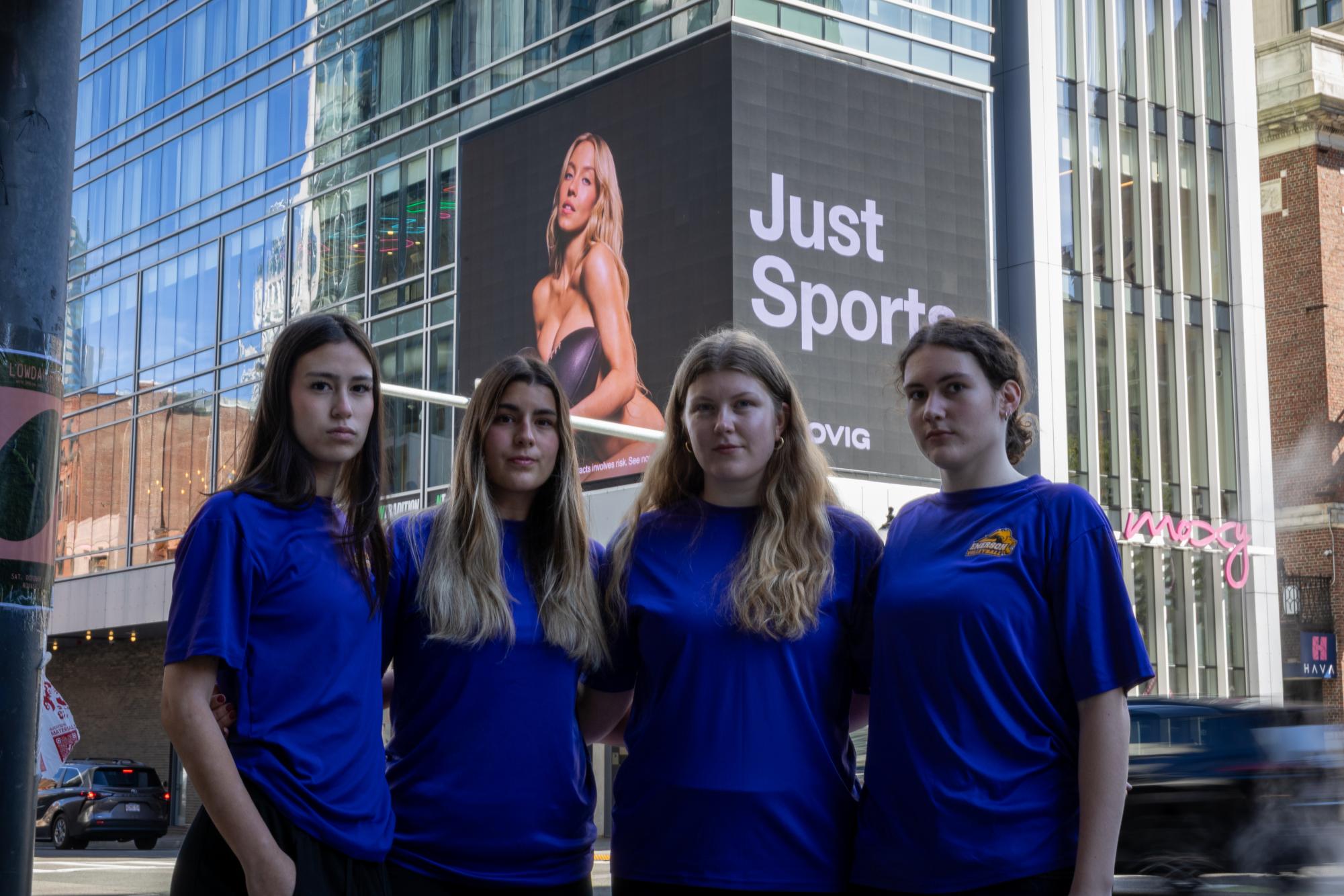
It is hard for me to put into words just how much I despise Sydney Sweeney’s “Just Sports” ad, but I’ll let my frustration as a female athlete speak for itself. The ad features Sweeney promoting the sports betting site, Novig, as she models various sports equipment. In the opening frame of the video, viewers see Sweeney wearing nothing except two footballs held against her chest. The ad was viewed nearly 39 million times in six days.
Professional athletes across the sports industry were quick to push back. Olympic swimmer Ariarne Titmus said the ad left her infuriated and questioned how anyone could “monetize a woman’s body” and sexualize her sport. English sprinter Amy Hunt responded to the ad, saying it doesn’t show what women in sports actually look like, pointing instead to “muscle, hard work, sweat, blood, and tears.” Former collegiate gymnast Gracie Kramer said she’s spent her whole life competing in a sport where female athletes are “oversexualized, reduced to our bodies, and forced to fight to be taken seriously for what we can actually do.”
Sweeney’s response was to post ESPN Body Issue covers of nude athletes, including Serena Williams and Megan Rapinoe, suggesting there was a double standard. But there’s a big difference between a credible publication celebrating a high-performing athlete’s strength and a gambling company using a woman’s sexuality as a hook. Sweeney is also an equity partner in Novig, giving her a financial stake in the attention.
Some ask why any of this matters, since the ad is about betting, not women’s sports. I understand that perspective, and technically, the ad isn’t about women’s sports. But as someone studying marketing, I know that nothing in an ad is accidental, meaning the agency intentionally chose every prop and every frame. Those choices are hard to separate from the larger conversation about how women in sports are treated.
It’s clear that outrage keeps the ad in circulation, and the attention is reaching the audience Novig wants: men, who make up a majority of prediction market users. The ad has reached everywhere, from billboards in Times Square, all the way to Emerson College students, who have seen it on a screen at the Moxy Hotel on Tremont Street.
Critics say the ad encourages the objectification of female bodies and minimizes women’s contributions to sports, and that’s especially true for women trying to be taken seriously in sports media. Female sports journalists already have to prove they know the game, the stats, and the sport itself to be taken seriously. An ad that dares viewers to “prove it” while presenting a woman as a body, feeds the assumption that we’re there to be looked at rather than listened to. As a female journalism student, it’s concerning to think about how this impacts my future.
A sexualized image of a woman in athletic gear could easily convince someone that this is what being a woman in sports is supposed to look like. That’s far from the truth, and it makes me sad to imagine this could be a little girl’s first impression of being an athlete. Girls shouldn’t have to feel like they need to look a certain way to participate in sports. Women are already at a disadvantage in a male-dominated industry, constantly being told we don’t belong or don’t understand what’s happening, and this ad only boosts that sentiment.
Good Good x Callaway Advertisement
During an unfortunately similar scenario in August, golf media company Good Good and equipment maker Callaway promoted a co-branded driver with yet another controversial campaign. The ad opened with Good Good co-founder Garrett Clark shoulder-checking golfer Alexis Miestowski to the ground as she reached for his club. In the 15-second version, he stands over her and warns, “Do not touch my driver.”
Clark originally compared the idea to the 2026 horror movie “Obsession,” and said the goal was to create a creepy thriller vibe similar to that seen in the film. The execution, though, was far from perfect.
I don’t believe any brand sets out to make light of violence against women, but that’s how it landed. I saw a number of female athletes, specifically professional golfers, pointedly respond by assuring Callaway they’d stay far away from its driver. I will also be shopping for a new set of irons, of course.
The ad was pulled, and the fallout was swift. Callaway’s CEO admitted the company reviewed and approved the video before it went live. Clark apologized, saying, “This is not, at all, what we stand for.”
On Aug. 27, Callaway cut ties with Good Good after three years and committed $1 million to organizations that work to prevent violence against women. “These actions do not undo the harm caused or our role in it,” the company said. Good Good has since lost a partnership with the PGA Tour.
It’s good that consequences followed. But it’s worth asking how many people looked at that ad and agreed with its unintentional statement.
The Real Cost for Women Who Play
Neither ad treats a woman as an athlete. In one, she’s an object to sell a product. In the other, she’s a prop to be knocked down. That reduction isn’t abstract for those of us who play. I’ve personally felt pressure to wear makeup or do my hair for games, as if that would make me play stronger or be faster. It’s part of a larger pattern of women feeling watched and judged for how we look rather than how we perform.
“I definitely haven’t always been taken seriously as an athlete just because I’m a girl,” said Lindsay Gould, a junior on Emerson’s women’s basketball team, reflecting on the reality of being a female athlete. “It’s the difference between hearing ‘you’re good for a girl’ and simply hearing ‘you’re a good basketball player.’ It seems subtle, but those kinds of microaggressions are part of what continues to make women in sports feel less valued.”
Still, there’s reason for optimism. Women’s sports have made more progress in the last decade than they have in any decade, with more exposure, more events, and more excitement than ever. Stars like Caitlin Clark have helped pull new fans into the WNBA and women’s basketball in 2025 was the most-consumed season ever, with viewership up 16% from the year before. The growth reaches my own sport, too. ESPN’s coverage of the 2025 NCAA women’s volleyball tournament drew 13% more viewers than the year before.
That’s the story brands should be telling. Women’s athletics are finally getting the recognition they’ve deserved, and it’s disappointing to watch advertising that keeps reducing women to their appearance. The athletes are already impressive on their own, and brands don’t need to shove or strip them down to prove it.
. Your task is to write a brand-new article using the core information from the source while completely reimagining its structure, phrasing, and presentation.
Guidelines for Content Creation
Tone & Style:
Use a neutral, professional, and informative tone.
Ensure the language is clear, concise, and engaging for a broad audience.
Avoid subjective opinions or commentary—stick strictly to the facts.
Content Requirements:
Do not copy sentences verbatim; instead, paraphrase, restructure, and enhance the information while keeping all details intact.
Present a fresh perspective while preserving the factual accuracy of the original content.
Use concise, well-organized sections to improve readability.
Ensure all data, statistics, and sources remain accurate without distortion.
Quote & Attribution Rules (Strictly Enforced):
Direct quotes must remain unchanged—never reword or modify a quote.
All direct quotes must be accurately attributed to their original speaker.
Correct Example: “Innovation is the key to growth,” said John Doe, CEO of TechCorp.
If an interviewee clarifies a misconception (e.g., Fonda distancing herself from “No pain, no gain”), retain their exact wording to ensure accuracy.
If the original article attributes information to a source, ensure that attribution is retained.
Original: According to a report by Bloomberg, the industry is expected to grow 20% by 2026.
Correct Rewrite: Bloomberg reports that the industry is projected to expand by 20% by 2026.
Never misattribute or create false attributions.
Formatting & Structure (HTML Required):
Write the article in valid HTML format to ensure proper webpage display.
Use headings for major sections and subheadings for key points where applicable.
Keep paragraphs short and scannable to enhance online readability.
Include bullet points or numbered lists where useful for breaking down complex information.
SEO & Readability Guidelines:
Follow SEO best practices:
Use descriptive, keyword-rich headings that naturally fit the topic.
Incorporate primary and secondary keywords strategically without overstuffing.
Ensure a clean, semantic HTML structure that improves search engine indexing.
Where relevant, include:
Meta descriptions summarizing the article in under 160 characters.
Alt text for any referenced images.
Internal and external links where applicable (only if relevant to the article’s content).
Hyperlinks & Source Retention:
Retain only links that serve a clear purpose, such as:
Product links that are relevant to the article.
Source links for studies, reports, or direct quotes.
Remove all unnecessary links, including:
Newsletter sign-up links
“Related Articles,” “Read More,” or “Suggested Content” links
Unrelated promotional or self-referential links
Do not replace removed links with generic text.
Example of correct link formatting in HTML:
For more information, visit this source.
Additional Considerations:
The article must be completely original and uniquely worded—it should not resemble the source in structure or phrasing.
Ensure the final output is engaging, logically structured, and free of errors.
Do not fabricate facts, misinterpret data, or introduce speculation.
Fact-check when necessary to ensure all referenced information is up to date.
Instructions for Execution:
Analyze the source content and identify its core information and key takeaways.
Reimagine the structure while ensuring factual integrity and a fresh perspective.
Write a fully original article that adheres to all tone, SEO, and formatting guidelines.
