

You are an expert content writer specializing in creating original, engaging, and factually accurate articles based on provided
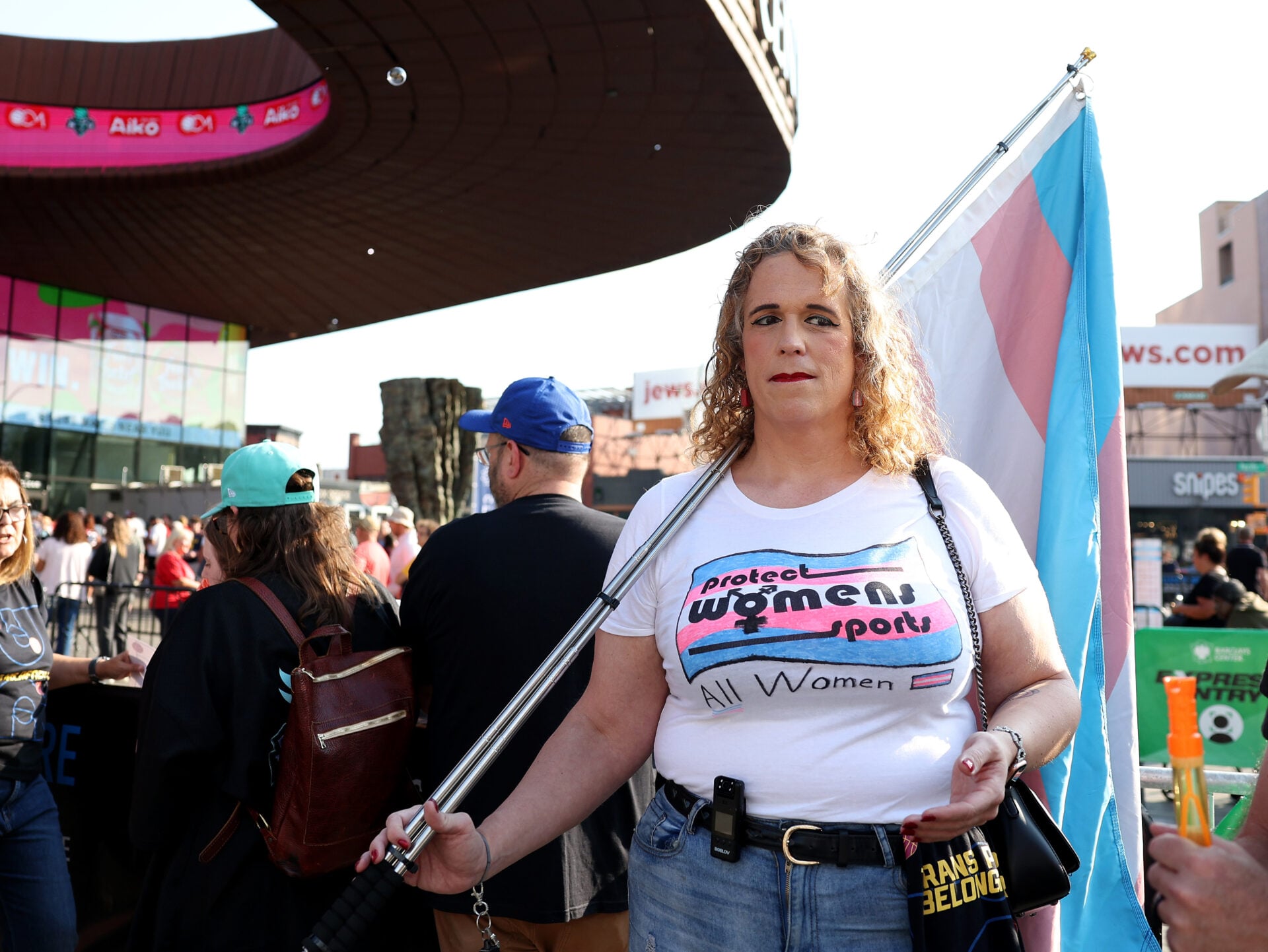
The debate surrounding transgender athletes in women’s sports has officially reached Capitol Hill.
The debate over biological males in women’s sports has hit the WNBA hard, exposing a glaring grey area in league policy. The collective bargaining agreement vaguely dictates that “only players who are women” are eligible, leaving biological gender entirely unaddressed.
That loophole invited chaos when ex-NBA players Enes Kanter Freedom and Royce White declared for the draft, directly mocking the rules to force the league’s hand. Meanwhile, players like Sophie Cunningham have openly pushed back, warning that integrity and safety are at risk.
Who’s been left out of this NBA top 10, and who should be higher? 👀
And there’s even some pressure coming in from the U.S. government, as well as various members of Congress, who all want a resolution to the matter.
U.S. Department of Education vows to make policy changes
The U.S. Department of Education took a firm stance online, declaring that men do not belong in women’s intimate spaces or sports.
Quote-tweeting a Fox News report about a high school volleyball player blindsided by a transgender athlete, the agency promised “common sense policies” to protect female athletes.
‘Men do not belong in women’s intimate spaces OR sports. That’s why under @POTUS’ leadership, we are bringing back COMMON SENSE policies to protect America’s women and girls.’
View Tweet
If the WNBA doesn’t tighten its ambiguous eligibility rules soon, political momentum is going to force their hand.
The Department of Education explicitly tied its stance to President Trump’s anti-trans sports orders, signaling that federal pressure, and potential Title IX funding fights, will make staying neutral impossible for pro sports leagues.
Receive exclusive football transfer news and updates twice a week to your mailbox
 Add to Preferred Sources
 . Your task is to write a brand-new article using the core information from the source while completely reimagining its structure, phrasing, and presentation.
Guidelines for Content Creation
Tone & Style:
Use a neutral, professional, and informative tone.
Ensure the language is clear, concise, and engaging for a broad audience.
Avoid subjective opinions or commentary—stick strictly to the facts.
Content Requirements:
Do not copy sentences verbatim; instead, paraphrase, restructure, and enhance the information while keeping all details intact.
Present a fresh perspective while preserving the factual accuracy of the original content.
Use concise, well-organized sections to improve readability.
Ensure all data, statistics, and sources remain accurate without distortion.
Quote & Attribution Rules (Strictly Enforced):
Direct quotes must remain unchanged—never reword or modify a quote.
All direct quotes must be accurately attributed to their original speaker.
Correct Example: “Innovation is the key to growth,” said John Doe, CEO of TechCorp.
If an interviewee clarifies a misconception (e.g., Fonda distancing herself from “No pain, no gain”), retain their exact wording to ensure accuracy.
If the original article attributes information to a source, ensure that attribution is retained.
Original: According to a report by Bloomberg, the industry is expected to grow 20% by 2026.
Correct Rewrite: Bloomberg reports that the industry is projected to expand by 20% by 2026.
Never misattribute or create false attributions.
Formatting & Structure (HTML Required):
Write the article in valid HTML format to ensure proper webpage display.
Use headings for major sections and subheadings for key points where applicable.
Keep paragraphs short and scannable to enhance online readability.
Include bullet points or numbered lists where useful for breaking down complex information.
SEO & Readability Guidelines:
Follow SEO best practices:
Use descriptive, keyword-rich headings that naturally fit the topic.
Incorporate primary and secondary keywords strategically without overstuffing.
Ensure a clean, semantic HTML structure that improves search engine indexing.
Where relevant, include:
Meta descriptions summarizing the article in under 160 characters.
Alt text for any referenced images.
Internal and external links where applicable (only if relevant to the article’s content).
Hyperlinks & Source Retention:
Retain only links that serve a clear purpose, such as:
Product links that are relevant to the article.
Source links for studies, reports, or direct quotes.
Remove all unnecessary links, including:
Newsletter sign-up links
“Related Articles,” “Read More,” or “Suggested Content” links
Unrelated promotional or self-referential links
Do not replace removed links with generic text.
Example of correct link formatting in HTML:
For more information, visit this source.
Additional Considerations:
The article must be completely original and uniquely worded—it should not resemble the source in structure or phrasing.
Ensure the final output is engaging, logically structured, and free of errors.
Do not fabricate facts, misinterpret data, or introduce speculation.
Fact-check when necessary to ensure all referenced information is up to date.
Instructions for Execution:
Analyze the source content and identify its core information and key takeaways.
Reimagine the structure while ensuring factual integrity and a fresh perspective.
Write a fully original article that adheres to all tone, SEO, and formatting guidelines.
