

You are an expert content writer specializing in creating original, engaging, and factually accurate articles based on provided
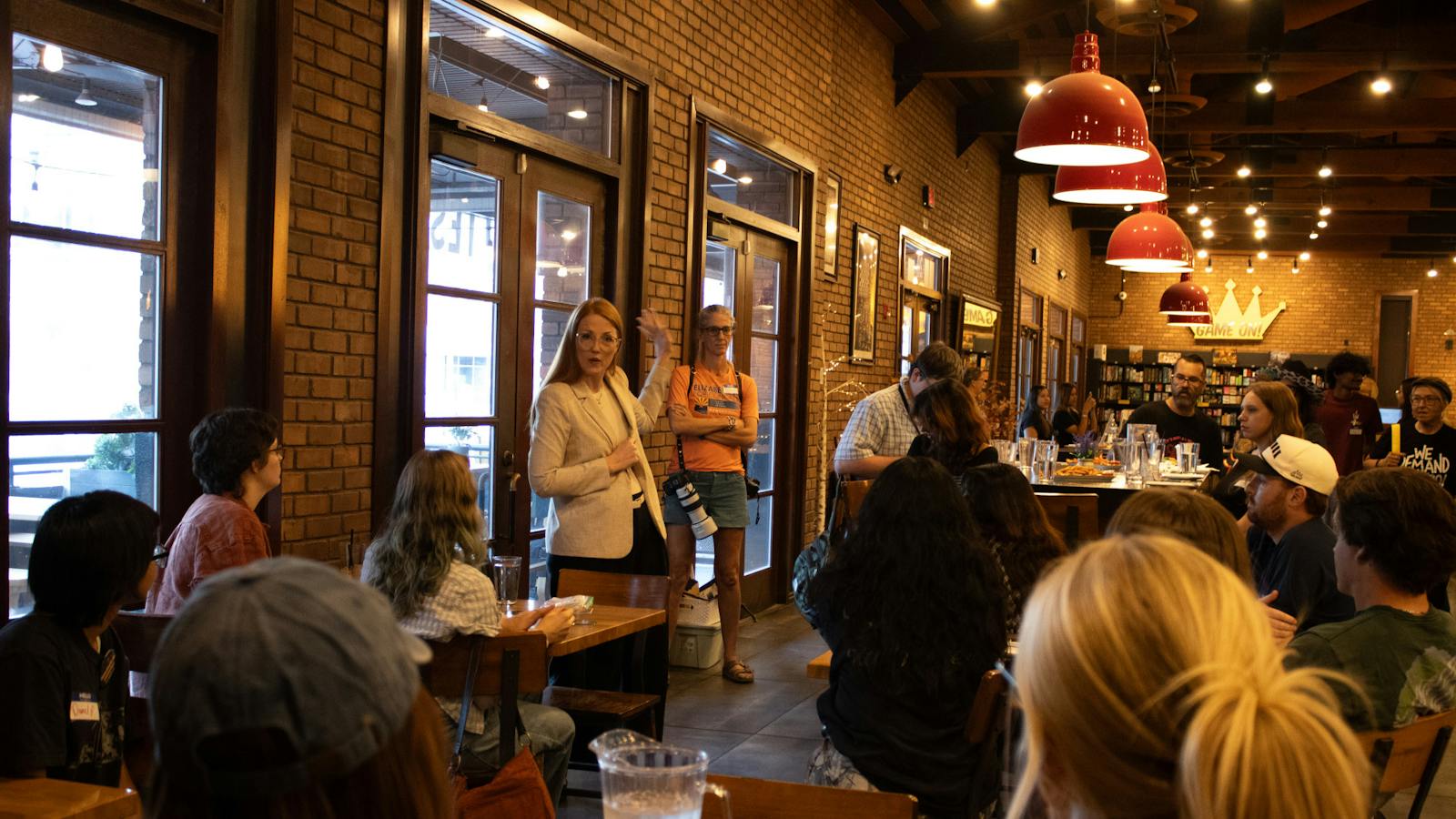
Democratic congressional candidate Elizabeth Lee attended a women’s safety happy hour Monday at Snakes & Lattes in Tempe, hosted by Arizona State University Young Democrats, to discuss how students can be safer on and off campus.
Lee and event attendees pointed to dangers facing female students on college campuses and said more work needs to be done to stop gender-based violence.
During her speech, Lee discussed her stance on the importance of women’s safety and government accountability.
“We sure as hell have money to put these test strips on college campuses, in bathrooms, in dorms, in places where people who benefit from their use have access to them,” Lee said.
Lee is a reproductive health nurse running for Congress in a district that includes parts of Chandler, Mesa and Queen Creek. She is running against Republican Mark Lamb, a former Pinal County sheriff.
Incumbent Rep. Andy Biggs, a Republican, is running for Arizona governor and leaving the seat open.
Students should expect more from their leaders, Lee said, and they should be working “far harder” to protect the community and prevent violence against women, minorities and youth.
“When I pay taxes, I expect my taxes to go towards the betterment of the community,” Lee said.
Lee spoke alongside Joy Hoover, CEO of Esōes Cosmetics, about how students can protect themselves.
Hoover said she wanted to partner with Lee to discuss the importance of safety with students.
“When she asked, we did not hesitate,” Hoover said.
Esōes Cosmetics is a company manufacturing women’s personal safety tools disguised as makeup products. Hoover founded the company to create innovative ways for women to protect themselves from targeted violence by utilizing tech-enabled beauty and community advocacy, according to its website.
Hoover said shehas been involved in the women’s safety industry for 16 years, supporting survivors of trafficking and gender-based violence.
“This is a preventable issue,” Hoover said. “We just have to come together to prevent it.”
According to the Rape, Abuse & Incest National Network, one in eight students experiences sexual violence during college, and the first year specifically is considered a high-risk time. Of undergraduate women, 16% reported experiencing nonconsensual sexual contact by physical force or inability to consent in their first year.
“Our whole mission is to make sure that you’re safer, and that’s safe drinking, safe partying, safe walking to your car, just a little bit of safety wherever you go,” Hoover said.
Hoover created a customizable Esōes safety app allowing students to easily share their location or sound an alarm if they feel like they are in danger.
Her company sells a variety of self-defense tools to protect women when they are in public spaces, like cup covers, test strips for drinks and lip glosses featuring shades “It’s Not The Dress” and “No Means No.”
Alisha Usman is the social chair for ASU Young Democrats and a junior studying political science and justice studies. She said Lee’s team reached out to the club and the organizations began planning the event in July.
Usman said she wanted to help organize the event because of the importance of making sure women feel safe on campus.
“It’s not really talked about as much as it should be,” Usman said.
Edited by Andi Ruiz, Carsten Oyer, Grace Lawrence, Kate Gore and Sophia Keeling.
Reach the reporter at achern41@asu.edu.
Like The State Press on Facebook and follow @statepress on X.
Ariana HernandezPolitics Reporter
Ariana Hernandez is a part-time reporter at The State Press. This is her first semester with The State Press. She is in her sophomore year studying Journalism and Political Science.
. Your task is to write a brand-new article using the core information from the source while completely reimagining its structure, phrasing, and presentation.
Guidelines for Content Creation
Tone & Style:
Use a neutral, professional, and informative tone.
Ensure the language is clear, concise, and engaging for a broad audience.
Avoid subjective opinions or commentary—stick strictly to the facts.
Content Requirements:
Do not copy sentences verbatim; instead, paraphrase, restructure, and enhance the information while keeping all details intact.
Present a fresh perspective while preserving the factual accuracy of the original content.
Use concise, well-organized sections to improve readability.
Ensure all data, statistics, and sources remain accurate without distortion.
Quote & Attribution Rules (Strictly Enforced):
Direct quotes must remain unchanged—never reword or modify a quote.
All direct quotes must be accurately attributed to their original speaker.
Correct Example: “Innovation is the key to growth,” said John Doe, CEO of TechCorp.
If an interviewee clarifies a misconception (e.g., Fonda distancing herself from “No pain, no gain”), retain their exact wording to ensure accuracy.
If the original article attributes information to a source, ensure that attribution is retained.
Original: According to a report by Bloomberg, the industry is expected to grow 20% by 2026.
Correct Rewrite: Bloomberg reports that the industry is projected to expand by 20% by 2026.
Never misattribute or create false attributions.
Formatting & Structure (HTML Required):
Write the article in valid HTML format to ensure proper webpage display.
Use headings for major sections and subheadings for key points where applicable.
Keep paragraphs short and scannable to enhance online readability.
Include bullet points or numbered lists where useful for breaking down complex information.
SEO & Readability Guidelines:
Follow SEO best practices:
Use descriptive, keyword-rich headings that naturally fit the topic.
Incorporate primary and secondary keywords strategically without overstuffing.
Ensure a clean, semantic HTML structure that improves search engine indexing.
Where relevant, include:
Meta descriptions summarizing the article in under 160 characters.
Alt text for any referenced images.
Internal and external links where applicable (only if relevant to the article’s content).
Hyperlinks & Source Retention:
Retain only links that serve a clear purpose, such as:
Product links that are relevant to the article.
Source links for studies, reports, or direct quotes.
Remove all unnecessary links, including:
Newsletter sign-up links
“Related Articles,” “Read More,” or “Suggested Content” links
Unrelated promotional or self-referential links
Do not replace removed links with generic text.
Example of correct link formatting in HTML:
For more information, visit this source.
Additional Considerations:
The article must be completely original and uniquely worded—it should not resemble the source in structure or phrasing.
Ensure the final output is engaging, logically structured, and free of errors.
Do not fabricate facts, misinterpret data, or introduce speculation.
Fact-check when necessary to ensure all referenced information is up to date.
Instructions for Execution:
Analyze the source content and identify its core information and key takeaways.
Reimagine the structure while ensuring factual integrity and a fresh perspective.
Write a fully original article that adheres to all tone, SEO, and formatting guidelines.
