

You are an expert content writer specializing in creating original, engaging, and factually accurate articles based on provided
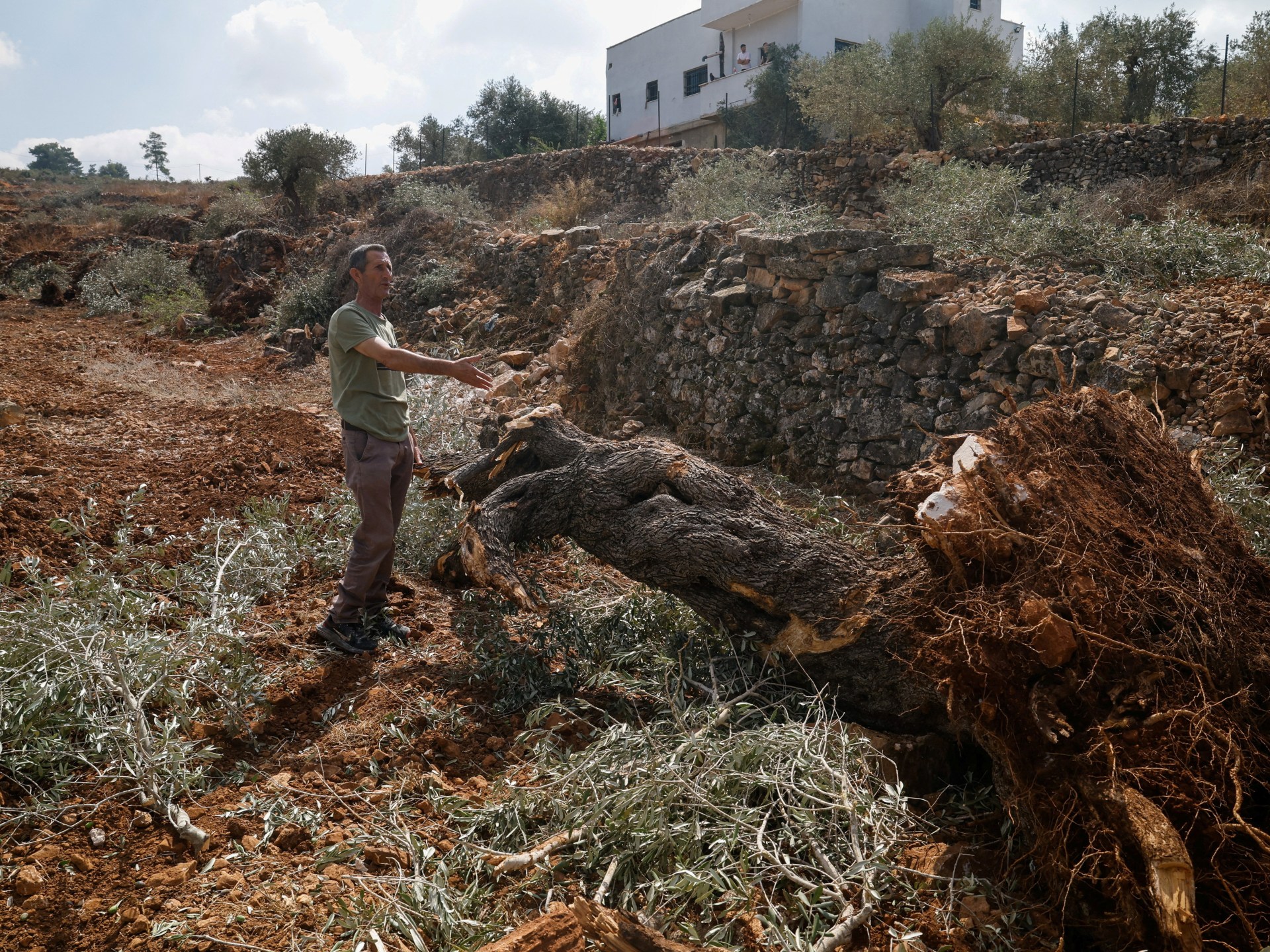
Israeli bulldozers uprooted olive groves near Ramallah in the occupied West Bank weeks before the annual harvest.
Published On 24 Sep 2026
Israeli army bulldozers have ploughed through rows of olive trees in a village near Ramallah in the occupied West Bank, just as Palestinian farmers were preparing to begin their annual harvest, residents told the Reuters news agency.
Palestinian farmer and landowner Abd Alfattah Tamimi said the army had destroyed the olive trees planted on his family’s land as well as his neighbours’.
Recommended Stories
list of 3 itemsend of list
The demolition in the village of Deir Nidham started on Monday and continued on Tuesday, the Palestinian news agency Wafa reported.
“They don’t care about anyone, but God is up there, and we are steadfast here with our souls,” he said. “They are uprooting, and we will plant again with the help of God,” he said.
Another farmer, Nather Tamimi, told Reuters the timing of the demolition was designed to inflict maximum damage ahead of harvest season, which traditionally begins in October.
He said that his family produced about 120 drums of olive oil from the land each year.
The Israeli army also “uprooted all kinds of trees even from between the houses”, Nather Tamimi said.
Israel’s military said it was checking Reuters’ request for comment but had not responded by Wednesday evening.
In the past, Israel has cited the need to clear land of olive trees to prevent security threats or ambushes on troops.
Palestinian human rights groups reject this, saying the destruction in effect deprives Palestinian farmers of income from the sale of olives and olive oil, while uprooting trees they view as a symbol of their connection to the land.
The Palestinian Authority’s Colonization and Wall Resistance Commission said Israeli attacks on agricultural land in August affected 21,508 trees, including 19,375 olive trees.
They estimated this year’s olive production at 21,000 tonnes, compared with local demand of about 15,000 tonnes.
. Your task is to write a brand-new article using the core information from the source while completely reimagining its structure, phrasing, and presentation. Guidelines for Content Creation Tone & Style: Use a neutral, professional, and informative tone. Ensure the language is clear, concise, and engaging for a broad audience. Avoid subjective opinions or commentary—stick strictly to the facts. Content Requirements: Do not copy sentences verbatim; instead, paraphrase, restructure, and enhance the information while keeping all details intact. Present a fresh perspective while preserving the factual accuracy of the original content. Use concise, well-organized sections to improve readability. Ensure all data, statistics, and sources remain accurate without distortion. Quote & Attribution Rules (Strictly Enforced): Direct quotes must remain unchanged—never reword or modify a quote. All direct quotes must be accurately attributed to their original speaker. Correct Example: “Innovation is the key to growth,” said John Doe, CEO of TechCorp. If an interviewee clarifies a misconception (e.g., Fonda distancing herself from “No pain, no gain”), retain their exact wording to ensure accuracy. If the original article attributes information to a source, ensure that attribution is retained. Original: According to a report by Bloomberg, the industry is expected to grow 20% by 2026. Correct Rewrite: Bloomberg reports that the industry is projected to expand by 20% by 2026. Never misattribute or create false attributions. Formatting & Structure (HTML Required): Write the article in valid HTML format to ensure proper webpage display. Use headings for major sections and subheadings for key points where applicable. Keep paragraphs short and scannable to enhance online readability. Include bullet points or numbered lists where useful for breaking down complex information. SEO & Readability Guidelines: Follow SEO best practices: Use descriptive, keyword-rich headings that naturally fit the topic. Incorporate primary and secondary keywords strategically without overstuffing. Ensure a clean, semantic HTML structure that improves search engine indexing. Where relevant, include: Meta descriptions summarizing the article in under 160 characters. Alt text for any referenced images. Internal and external links where applicable (only if relevant to the article’s content). Hyperlinks & Source Retention: Retain only links that serve a clear purpose, such as: Product links that are relevant to the article. Source links for studies, reports, or direct quotes. Remove all unnecessary links, including: Newsletter sign-up links “Related Articles,” “Read More,” or “Suggested Content” links Unrelated promotional or self-referential links Do not replace removed links with generic text. Example of correct link formatting in HTML:
For more information, visit this source.
Additional Considerations: The article must be completely original and uniquely worded—it should not resemble the source in structure or phrasing. Ensure the final output is engaging, logically structured, and free of errors. Do not fabricate facts, misinterpret data, or introduce speculation. Fact-check when necessary to ensure all referenced information is up to date. Instructions for Execution: Analyze the source content and identify its core information and key takeaways. Reimagine the structure while ensuring factual integrity and a fresh perspective. Write a fully original article that adheres to all tone, SEO, and formatting guidelines.
