


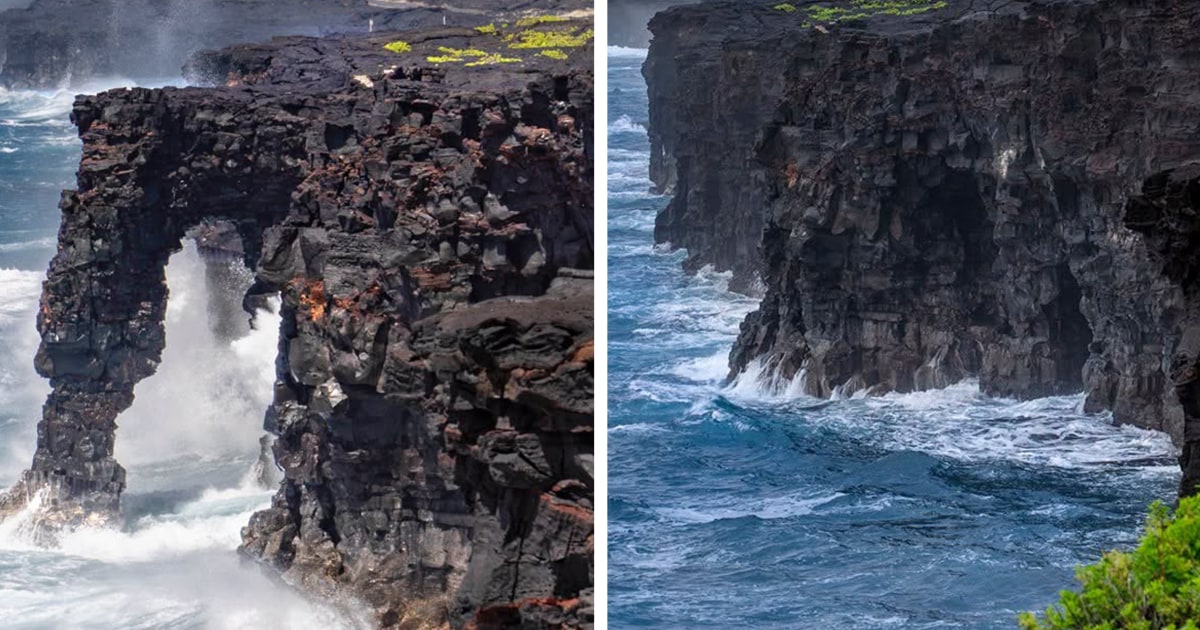
Collapse of Hōlei Sea Arch at Hawai’i Volcanoes National Park
The iconic Hōlei Sea Arch, recognized for its striking formation and historical significance, has been officially declared “Permanently closed” on Google Maps following its recent collapse. This natural feature, a 90-foot arch sculpted by centuries of volcanic activity and ocean erosion, succumbed to the forces of nature between September 23 and the end of September during adverse weather conditions.
Details of the Collapse
According to the National Park Service (NPS), the collapse occurred during a period when the park was temporarily closed due to Tropical Storm Nolo. The arch’s demise is attributed to a long-standing process of erosion exacerbated by recent geological activity.
Geological Background
The Hōlei Sea Arch had its roots in 550-year-old lava flows and was continually shaped by the relentless action of the Pacific Ocean. The NPS acknowledged that the arch’s collapse is part of a predictable cycle, indicating that the structural weaknesses of the arch were likely compounded by the seismic activity from the 2018 Kīlauea eruption, which had already damaged surrounding cliffs.
Public Safety Concerns
In light of the collapse, the park service has issued warnings regarding visitor safety. Observations on social media showed individuals approaching unstable cliff edges, prompting the NPS to advise against getting too close to the hazardous areas. The cliffs pose a significant risk of falling, which could lead to severe injuries or fatalities.
The NPS urged visitors to maintain a safe distance from the coastal cliffs, where vertical drops present a high danger. “Visitors are urged to stay back from the unstable coastal cliff edges which drop off vertically into the ocean and present a serious falling hazard,” the agency stated in its message to the public.
Ongoing Erosion and Future Outlook
The effects of oceanic erosion on the Hōlei Sea Arch have been well-documented. The U.S. Geological Survey noted that the arch was formed through differential erosion, where ocean waves gradually wear away the weaker segments of the basalt rock. “Every day the ocean crashes against the pillar of the arch, eroding it a little more,” they noted. “One day, it will be gone.”
To mitigate risks, NPS had previously relocated the viewing area further from the cliff edges after new cracks were observed in early 2020. Additionally, a chunk of the arch was lost during Tropical Storm Darby later that same year, highlighting the fragility of this natural phenomenon.
Conclusion
The collapse of the Hōlei Sea Arch serves as a stark reminder of the natural processes that shape our environment. While the loss of such a beautiful geological feature is lamentable, it also emphasizes the importance of respecting nature’s boundaries for safety and preservation.
