

You are an expert content writer specializing in creating original, engaging, and factually accurate articles based on provided
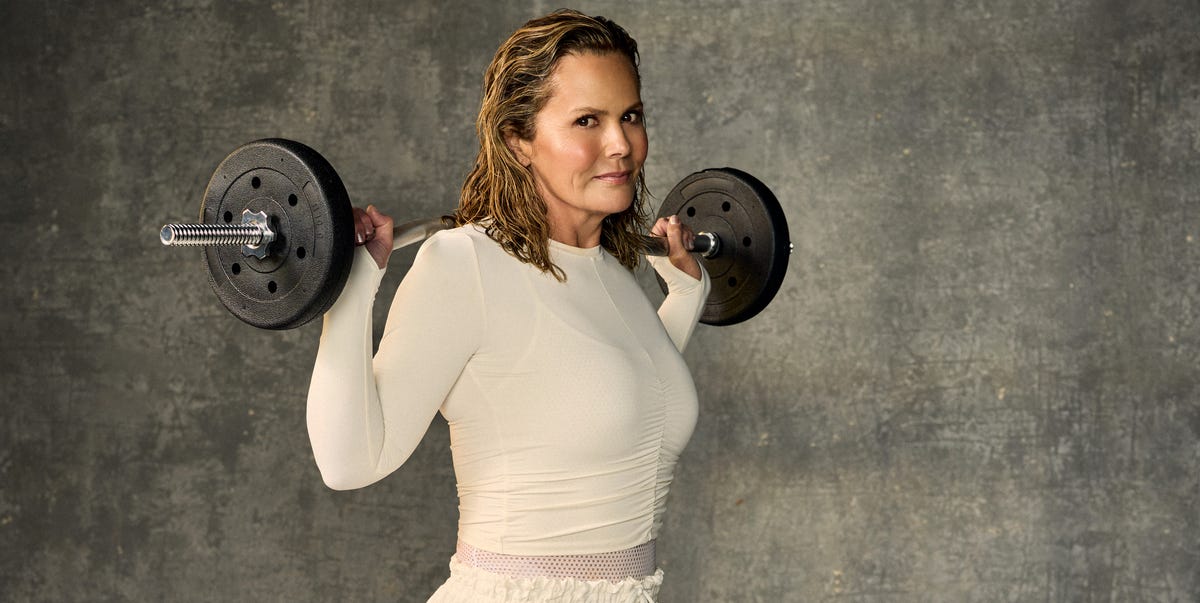
Liz Earle has become one of the UK’s leading voices on healthy ageing, but her strength-training routine is probably much shorter than you’d expect.
The 63-year-old entrepreneur and Women’s Health cover star says she doesn’t spend hours lifting weights. Instead, she relies on brief, consistent sessions that have helped her become, in her own words, ‘fitter, stronger, happier’ in her 60s.
Speaking on the Just As Well podcast, Liz explained that one of the biggest misconceptions about strength training is that it has to dominate your day.
‘I’ll lift some weights,’ she said. ‘I think one of the things that I’ve learnt, which is really good news, at least for me, if someone doesn’t really think of themselves as a gym person is, it’s short.
‘You know, you don’t have to train for hours.’
Want to train like Liz?
Her PT, Michael Garry, has created a 4-week training plan exclusively for members of the WH COLLECTIVE. It’s designed to remove one of the biggest barriers to fitness: time. You’ll train for just 35 minutes three times a week – Liz’s exact strategy to build muscle, boost metabolism and support long-term health. Tap the link below to unlock 14 free days of training and start Liz’s plan today.
Get the plan
Her routine includes weighted squats, push-ups, tricep dips, skipping and lat pulldowns, but she keeps the sessions deliberately concise.
‘I do weighted squats. I do my own body weight push ups. I bought myself a lat pulldown machine the Christmas before last. That was my Christmas present for myself,’ she said.
‘Again, just using my own body weight, but not for very long. I mean rarely for more than 20 minutes. I mean, it’s, it’s and maybe only three times a week. So it’s not that much.’
Rather than adding more time, Liz focuses on gradually increasing the challenge.
‘I think it’s for me and I’m not a personal trainer. I’m just relaying what I’ve been told by personal trainers who I work with. It’s better to do fewer reps with a heavier weight.’
She added: ‘I’ll do weighted squats every year. I kind of up my dumbbell weight. So I think I started on 16 kilo dumbbells, one in each hand like kettlebells to do weighted squats. Then it was 18, then it’s 20. My current dumbbells are 22s.’
For Liz, strength training isn’t about aesthetics. It’s about staying capable for decades to come.
‘I think as we get older, you know, for me working out now, it’s not really about how much you know, how I look or changing my shape for that. It’s about maintaining my independence. I want to be able to get up off the floor unaided. If I fall over, I want to be able to feel that I can carry my bags up an escalator that’s not working, and I don’t have to rely on somebody else to help me.’
You can read our full cover interview with Liz by hitting this link. Subscribe to Women’s Health here.

Isaac Williams is Site Editor for both Women’s Health UK and Men’s Health UK, guiding and supporting the content teams to create content across all platforms. Isaac’s love of health and fitness began at Loughborough University, where he graduated with a History and English degree in 2014. His first job was at Men’s Running magazine, where he progressed from Staff Writer to Editor. Among his highlights of those four years include completing a 24-hour track race (never again), just about finishing a multi-day ultramarathon in the Azores, and chugging his way around a ‘beer mile’. Isaac ventured into the world of freelance journalism in 2018, interviewing some of the biggest names in sport – like Anthony Joshua and Ben Stokes – and writing features for the likes of The Guardian, Red Bull, ShortList and BBC Countryfile. He was also a regular contributor to an adventure series called ‘The Man Who’: speaking to some of the world’s most extreme explorers from the wilds of Caffè Nero. In late-2019, Isaac became Editor of Men’s Fitness UK. In his five years there, Isaac was responsible for editing the monthly magazine and managing website content, ultimately helping the brand transition to a ‘digital-first’ approach. He joined Hearst UK as Multiplatform Editor in December 2024, where he manages day-to-day digital output, edits content and writes articles on all things health and fitness. When he’s not hammering at his keyboard, Isaac enjoys exercise and trying – unsuccessfully, so far – to teach his baby son to kick a football. You can follow Isaac on Instagram @isaacw1993.
. Your task is to write a brand-new article using the core information from the source while completely reimagining its structure, phrasing, and presentation.
Guidelines for Content Creation
Tone & Style:
Use a neutral, professional, and informative tone.
Ensure the language is clear, concise, and engaging for a broad audience.
Avoid subjective opinions or commentary—stick strictly to the facts.
Content Requirements:
Do not copy sentences verbatim; instead, paraphrase, restructure, and enhance the information while keeping all details intact.
Present a fresh perspective while preserving the factual accuracy of the original content.
Use concise, well-organized sections to improve readability.
Ensure all data, statistics, and sources remain accurate without distortion.
Quote & Attribution Rules (Strictly Enforced):
Direct quotes must remain unchanged—never reword or modify a quote.
All direct quotes must be accurately attributed to their original speaker.
Correct Example: “Innovation is the key to growth,” said John Doe, CEO of TechCorp.
If an interviewee clarifies a misconception (e.g., Fonda distancing herself from “No pain, no gain”), retain their exact wording to ensure accuracy.
If the original article attributes information to a source, ensure that attribution is retained.
Original: According to a report by Bloomberg, the industry is expected to grow 20% by 2026.
Correct Rewrite: Bloomberg reports that the industry is projected to expand by 20% by 2026.
Never misattribute or create false attributions.
Formatting & Structure (HTML Required):
Write the article in valid HTML format to ensure proper webpage display.
Use headings for major sections and subheadings for key points where applicable.
Keep paragraphs short and scannable to enhance online readability.
Include bullet points or numbered lists where useful for breaking down complex information.
SEO & Readability Guidelines:
Follow SEO best practices:
Use descriptive, keyword-rich headings that naturally fit the topic.
Incorporate primary and secondary keywords strategically without overstuffing.
Ensure a clean, semantic HTML structure that improves search engine indexing.
Where relevant, include:
Meta descriptions summarizing the article in under 160 characters.
Alt text for any referenced images.
Internal and external links where applicable (only if relevant to the article’s content).
Hyperlinks & Source Retention:
Retain only links that serve a clear purpose, such as:
Product links that are relevant to the article.
Source links for studies, reports, or direct quotes.
Remove all unnecessary links, including:
Newsletter sign-up links
“Related Articles,” “Read More,” or “Suggested Content” links
Unrelated promotional or self-referential links
Do not replace removed links with generic text.
Example of correct link formatting in HTML:
For more information, visit this source.
Additional Considerations:
The article must be completely original and uniquely worded—it should not resemble the source in structure or phrasing.
Ensure the final output is engaging, logically structured, and free of errors.
Do not fabricate facts, misinterpret data, or introduce speculation.
Fact-check when necessary to ensure all referenced information is up to date.
Instructions for Execution:
Analyze the source content and identify its core information and key takeaways.
Reimagine the structure while ensuring factual integrity and a fresh perspective.
Write a fully original article that adheres to all tone, SEO, and formatting guidelines.
