


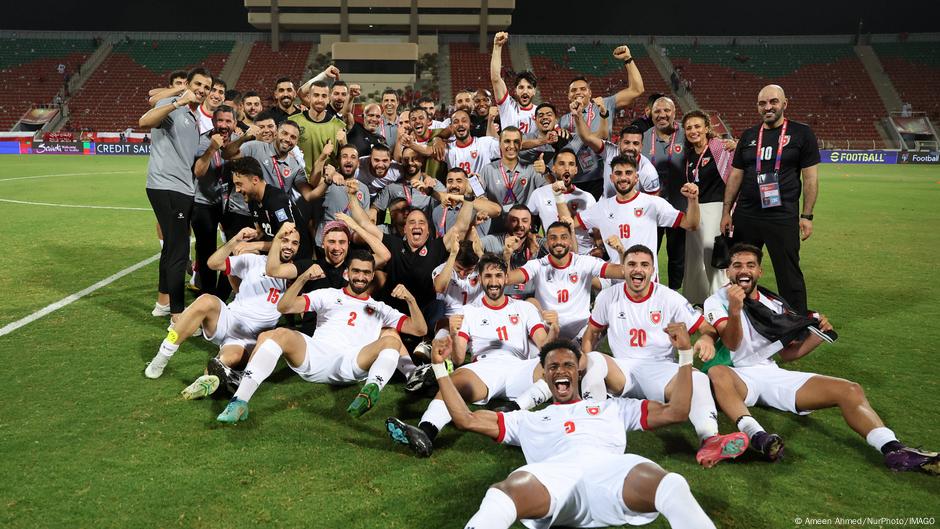
“We love football as much as any country in the world,” Ayah Hussein expressed to DW, highlighting the enthusiasm of female fans eager to support the Jordan men’s national team during their matches at Amman International Stadium.
According to Hussein, the atmosphere in local coffee shops has transformed, with female patrons equally excited to cheer for the Jordan flag as the team approaches the World Cup. “I can’t wait to watch the games next year,” she added. “It’s going to be a big party, as we have waited a long time for this.”
Jordan secured its place in the World Cup in an earlier match against Iraq, which served mainly as a friendly fixture. Next year marks a pivotal moment for the nation, as the men’s team prepares for its inaugural World Cup appearance. Following this, the Women’s World Cup is set to take place, with Jordan aspiring to qualify for the tournament. The women’s team has come close in previous years, aiming for a top-six finish in the 2026 Asian Cup to earn a ticket to Brazil in 2027.
Progress in Women’s Football
Jordan began its women’s football program in 2005, a time when participation was lacking in many West Asian nations, with only about 30 players available nationwide.
The fruit of sustained efforts over the last two decades is now evident. “We have players who have retired and are now working in the federation, you have female coaches, referees, and women involved in administration,” noted Rana Husseini, former president of the Jordan Football Association’s (JFA) women’s committee (2009-2018). She observed a significant increase in public interest since her tenure began when games drew merely the players’ families.
The upcoming season of the professional league in Jordan, set to commence in September, introduces teams competing for entry into the Asian Women’s Champions League, thereby establishing a competitive structure.
Overcoming Challenges
Leading the women’s football movement in Jordan has been Prince Ali bin Hussein, who has served as president of the JFA since 1999. He emphasized that “women are 50% of our society and should be involved in everything.” His influence was pivotal in the decision by FIFA to permit players to wear hijabs during matches in 2012.
However, challenges persist. In conservative settings, some resist women participating in sports. Husseini detailed instances of verbal attacks and cyberbullying faced by female players.
Events like Jordan hosting the Women’s U17 World Cup in 2016 have contributed to shifting perceptions, leading to broader acceptance of women in sports and encouraging participation across various societal segments.
Financial Gains and Future Opportunities
The men’s qualification for the World Cup holds financial promise, with projected prize money for the 2026 tournament estimated to be around double that of 2022. Reportedly, the Jordanian Football Association could see between $10 to $20 million from appearance fees, enhancing commercial sponsorship opportunities. This, in turn, bodes well for the women’s game.
Husseini highlighted that financial constraints remain a critical barrier to advancing women’s football. Increased funding from the men’s team’s success could lead to more teams, tournament participation, and travel opportunities.
Regional Developments
Jordan’s commitment to women’s football is mirrored by a growing number of Arab nations, such as Palestine, Bahrain, Lebanon, the UAE, and newcomers like Saudi Arabia and Iraq, all vying for spots in the upcoming World Cups. A regional approach could elevate the game’s development throughout West Asia.
Khalil Al-Salem, general secretary of the West Asian Football Federation, emphasized the importance of viewing Asia as a region rather than solely a continent, advocating for a competitive environment where nations motivate each other to develop women’s football.
The focus on grassroots initiatives in Jordan has led to opportunities for young girls, though many drop out of sports around age 17 to pursue education. The aspiration to see peers play at the World Cup could inspire them to continue their athletic careers.
In a time when socio-political tensions are high, football serves as a source of optimism for Jordan, particularly among the youth. Husseini remarked, “The fact that we finally got to reach the World Cup is going to reflect positively on the mood in Jordan, specifically among the younger generation.” This opportunity may cultivate a new generation of aspiring female athletes eager to represent their country on an international stage.
Edited by: Chuck Penfold
