


SQLDoom: Transforming Classic Gaming with SQL Databases
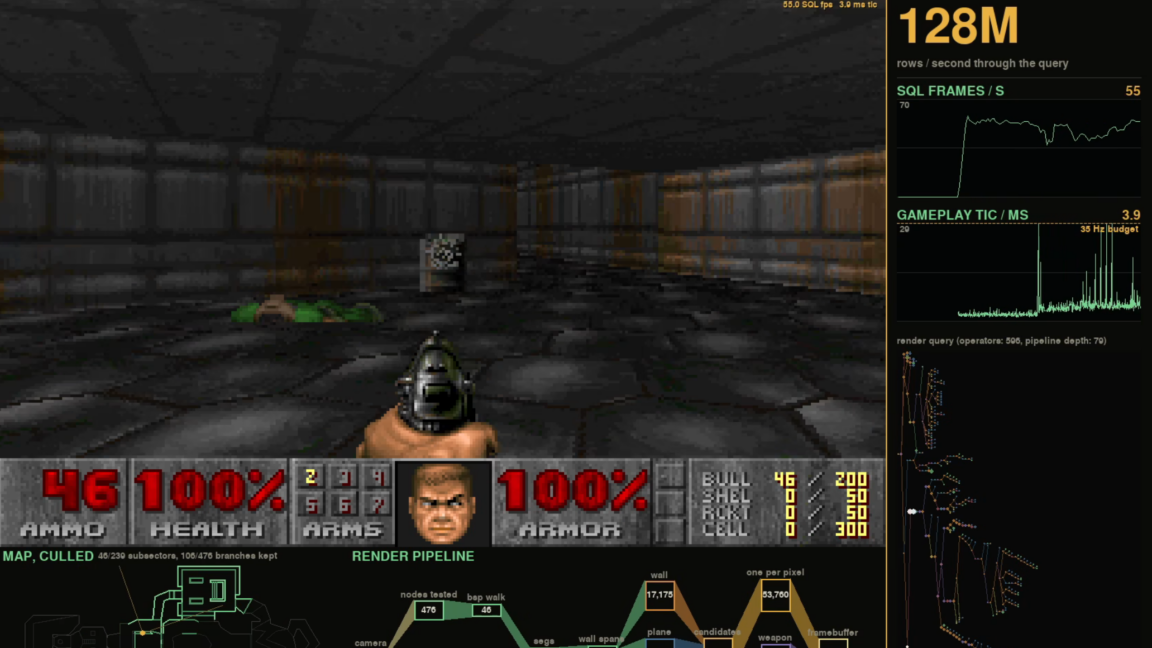
A groundbreaking project titled SQLDoom has emerged, showcasing an innovative method of rendering the classic game Doom utilizing an SQL database. While the concept seems unconventional, the execution is both calculated and creative, as outlined by Lukas Vogel in his blog.
How SQLDoom Operates
Despite its reliance on an SQL database, SQLDoom employs a lightweight Python client to manage user interactions and visual output, handling game timing and display. The game’s intricate mechanics are underpinned by a series of CedarDB tables that monitor geometry and game states. A robust 1,300 lines of SQL queries, organized across 89 common table expressions, implement extensive game logic, achieving a frame rate of 35 full-color bitmap frames per second.
A Step Forward from DoomQL
This project represents a significant advancement over Vogel’s earlier initiative, DoomQL, aimed at creating a multiplayer Doom-like shooter entirely using SQL. Unfortunately, that first attempt yielded limited success, resulting in grayscale ASCII graphics that evoked the simplistic design of Wolfenstein 3D. In contrast, SQLDoom provides vibrant, 640×480 visuals that are reminiscent of the original Doom gameplay experience.
The SQL Conversion Process
Vogel notes that the conversion process of Doom’s iconic WAD files to a relational database was relatively straightforward. The design of the original game lends itself well to this transformation due to its structural composition, which breaks the levels down into distinct elements such as vertices, lines, and sectors. Notably, Doom’s binary-space partition trees can be effectively represented in SQL, with a pre-calculated sort_key streamlining the rendering process. By employing an “ORDER BY” statement, the game efficiently determines which wall segments to display, optimizing overall performance.
Conclusion
SQLDoom illustrates the potential of integrating modern database systems with classic gaming architectures, pushing the boundaries of both technology and nostalgia. As the project continues to evolve, it showcases how innovative approaches can breathe new life into timeless classics.