


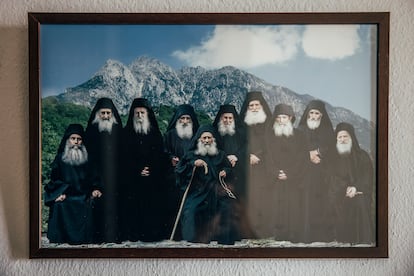
At the break of dawn, around 4:00 AM, monks at the Monastery of Saint Gregory on Mount Athos engage in early morning prayers. This revered site, known as the Garden of the Virgin Mary among Orthodox Christians, is enveloped in a blend of natural beauty and modern disturbances, where the serene sounds of the Aegean Sea and chirping birds are often overshadowed by the hum of electric generators and infrastructure projects funded by the Greek government and the European Union.
Mount Athos, an area roughly three times the size of Barcelona, maintains a unique aspect of exclusivity, where entry is restricted to men. This practice, known as “ávaton,” has been in effect for a millennium, prohibiting women—and even female animals—with a few exceptions. This regulation is firmly established in Greek law and recognized by all EU member states since Greece’s accession to the EU in 1981.
As a result, many treasures remain hidden from women, including one of the largest collections of Greek manuscripts, stunning frescoes, and numerous priceless Byzantine icons dating from the 12th to the 15th centuries. Women attempting to glimpse these wonders can only do so from cruise ship excursions that must maintain a distance of 500 meters from the shore.

Despite the longstanding tradition of the ávaton, some voices within Greece challenge its relevance, including journalist Stavros Tzimas, who argues that the ban could be reconsidered. However, many believers maintain that this exclusivity enhances Mount Athos’s allure among outsiders.
European Union Values and Gender Equality
The question of whether the ávaton aligns with the European Union’s commitment to gender equality is contentious. Lina Gálvez, a member of the EU Parliament and the socialist PSOE party, asserts, “Obviously, it is not compatible. [The prohibition] amounts to assuming that all women are impure. But it is also true that it is very difficult to do anything from the European Union [to change it], since that exception was already established when Greece joined.”
Ana Miranda, also part of the EU Parliament, echoes this sentiment, stating that the ávaton contravenes principles outlined in the Charter of Fundamental Rights of the EU. She emphasizes the need for EU representatives to confront this “gender apartheid” and stimulate discussions for its repeal, asserting that “half of the EU’s population” should not be restricted.
Conversely, Sakis Arnaoutoglou from the Greek socialist PASOK party highlights that the matter is more complex than mere equality: “It is also a matter of history, faith, culture and the way Europe approaches unique historical realities that have existed for centuries.” He acknowledges Mount Athos’s long-standing significance, which predates the EU itself, and argues that this intricacy necessitates respect for cultural differences.
Despite Greece making legal strides, such as supporting same-sex marriage, the nation still grapples with deeply rooted conservative social frameworks. The European Institute for Gender Equality (EIGE) reports that Greece ranks poorly on equality metrics within the EU, holding the 22nd spot out of 27 member states.
Geographically, Mount Athos extends approximately 50 kilometers long and 7 kilometers wide, lacking accessibility via roads. The primary access point is through the municipality of Ouranoupoli, where entry permits are issued at a cost of €25 for Orthodox pilgrims and €30 for others.
Perceptions of the Ávaton
Visitor opinions on the ávaton vary significantly. A Spanish mother and daughter visiting Ouranoupoli expressed contrasting views. The mother refers to the prohibition as “an aberration,” while her daughter, despite lamenting the lack of access to the monasteries, supports the ban, emphasizing the significance of historical rules and norms.
One of the most prominent monasteries, Simonos Petra, showcases religious relics without permitting photography. For women eager to view the icons, monks have devised a workaround, boarding small boats to interact with tourists and sell religious items from a distance.
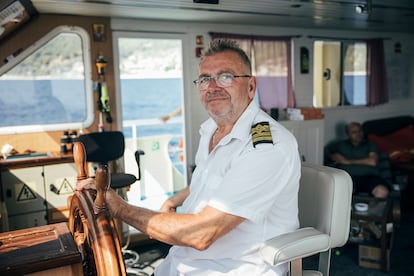
Captain Giorgos Rodokalakis, who runs one of these tourist vessels, expresses support for stricter regulations on the mountain, claiming that “women have a tricky mind and if they entered Athos they would destroy it.” He believes that the interaction between monks and women on the boats serves as a spiritual test for the monastics.
Visitors such as filmmaker Aliki Peterson respect the ávaton, believing that adherence to local customs is essential. Others express a desire for access but ultimately agree with maintaining the prohibition, viewing it as a necessary tradition associated with the sacredness of the site.
Historically, there have been instances of the ban being defied, most notably during World War II when monks sheltered individuals resisting Nazi occupation. Yet, the ávaton remains largely unchallenged within Greek society, even among those who identify with progressive viewpoints. Activist Litsa Amanatidou, who once breached the ban as part of a protest unrelated to gender issues, notes that the focus on gender equality encompasses a vast array of challenges that eclipse the significance of Mount Athos in contemporary debates.
While the EU appears uninterested in altering the status quo, Gálvez presents an intriguing proposal: opening discussions regarding EU support for projects on Mount Athos that could contravene EU principles. She suggests that financial assistance should not be allocated to areas that do not uphold fundamental EU values.
Currently, the ávaton continues to enjoy robust political, social, and financial backing, reflecting both the reverence for Mount Athos and the complexities of cultural traditions intertwined with modern European values.
