


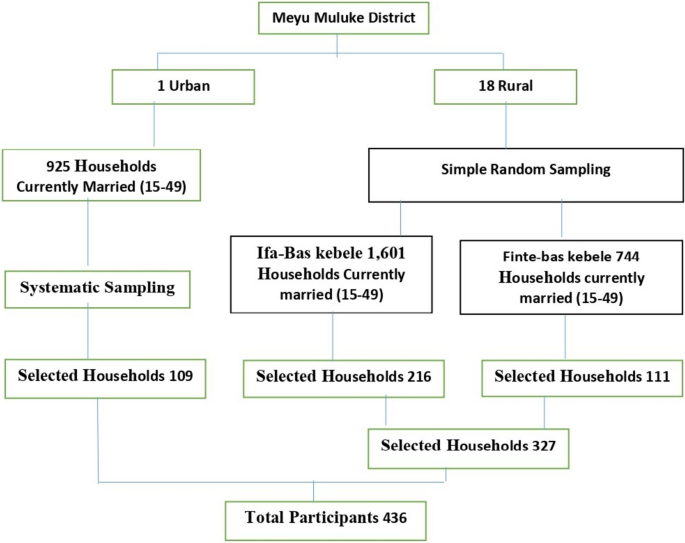
Overview of the Study Design
This article presents the findings of a community-based cross-sectional study aimed at assessing various factors related to family planning in Meyu Muluke woreda, located in eastern Ethiopia.
Study Duration
The research was conducted over a period of four weeks, specifically from February 1 to February 28, 2018.
Geographic Context
Meyu Muluke is positioned 557 kilometers from Addis Ababa, Ethiopia’s capital. It is part of the East Hararghe province, which comprises 19 districts. The woreda encompasses approximately 124 villages, organized into 19 kebeles. According to the 2016 Ethiopian Demographic and Health Survey (EDHS), the population in Meyu Muluke was recorded at 54,496, with a gender distribution of 23,400 men and 22,810 women. Urban residents made up 6.9% of the total. The predominant ethnic groups in the area are the Dinkas and Luo tribes. Many pastoral and agro-pastoral communities in this region encounter food insecurity due to recurring droughts and livestock losses. Health facilities in Meyu Muluke include 19 health posts and 5 health centers, staffed primarily by health extension workers. The study focused on one urban kebele and two rural kebeles, revealing a total population of reproductive age individuals of 817,424.
Target Population
The source population encompasses all currently married women of reproductive age residing in Meyu Muluke district. The study specifically targeted randomly selected married women in the reproductive age group who were available during the data collection phase. The initial report adhered to the Strengthening the Reporting of Observational Studies in Epidemiology (STROBE) guidelines.
Selection Criteria
Eligible participants included childbearing-aged women from both urban and rural areas in Meyu Muluke. The study focused on currently married women aged 15 to 49 years. Exclusions were made for those who were not living in union, infertile, or had been married for over five years without children in the past five years. Additionally, women who had never used contraception or were critically ill were also excluded from the study.
Data Collection Approach
Data were gathered using a structured, pretested questionnaire administered by trained interviewers. The questionnaire was adapted from existing literature and tailored to fit local contexts. It collected comprehensive information about participants’ knowledge, attitudes, sociodemographic details, and reproductive backgrounds. A team of seven BSc Nursing professionals, fluent in Afaan Oromo, conducted the interviews, coordinated by the principal investigator and public health specialists familiar with the locale. Data collection protocols included a rigorous pretest aimed at refining the questionnaire for clarity and relevance. The reliability of the tool was evaluated using Cronbach’s alpha, which yielded a score of 0.89, signaling acceptable reliability.
Variables Analyzed
Outcome Measure
The primary outcome analyzed was the unmet need for family planning, categorized as “Yes” or “No.”
Independent Variables
Key independent variables included:
- Age of the woman (grouped as 15–19, 20–24, 25–29, 30–34, and 35+ years)
- Place of residence (urban vs. rural)
- Ethnicity (Oromo vs. Amhara)
- Religion (Muslim vs. Christian)
- Education level (no formal education, primary, secondary, and higher)
- Occupation (housewife, farmer, daily laborer, government employee, merchant)
- Wealth index (categorized as low, middle, and high)
- Family size (2–3, 4–5, and 6 and above)
The analysis also encompassed reproductive variables – including age at first marriage, number of living children, age at first pregnancy, current pregnancy status, and pregnancy type. Furthermore, knowledge and attitudes toward contraceptives were assessed, covering awareness of contraceptives, sources of information, reasons for use, and discussions with health extension workers and partners.
Minimizing Biases
Efforts were made to address potential biases, such as social desirability and recall bias, by carefully rephrasing questions to avoid socially unacceptable responses.
Sample Size Determination
The sample size was calculated using a standard formula for population proportion estimation. Using a 95% confidence interval, the estimated proportion of unmet family planning needs was derived from prior studies, yielding a minimum sample size of 436 women after accounting for non-response.
Sampling Methodology
A multistage sampling strategy was implemented. Initially, two rural kebeles were chosen randomly from a total of 18, along with one urban kebele. The households in these kebeles were systematically numbered, and participants were selected using a k value of 6. The sampling method allowed for adjustments if an eligible respondent could not be located in the selected household.
Quality Control Measures
To ensure the reliability and validity of the data, the questionnaire underwent a comprehensive translation and back-translation process. Training was provided to data collectors and supervisors prior to the study to standardize the data collection protocol.
Data Processing and Analytical Techniques
Data were processed and analyzed using Epi-data 3.1 before being exported to SPSS version 25 for statistical analysis. Descriptive statistics, including frequency tables, were generated. A bivariable logistic regression was initially performed to identify variables with a p-value < 0.25, followed by multivariable logistic regression to determine statistically significant factors affecting unmet need for family planning, utilizing a confidence level of 95%. The model's goodness-of-fit was verified using the Hosmer–Lemeshow test, resulting in a non-significant p-value, indicating a well-fitted model. Multicollinearity was also assessed for all variables included in the analysis.
