


Study Overview
Between January and June 2024, a clinical study was conducted to examine the characteristics of women newly diagnosed with Polycystic Ovary Syndrome (PCOS) at several hospitals affiliated with the University of South China. Participants included women aged 20-49 who met the 2003 Rotterdam criteria for PCOS. For study inclusion, participants had to show at least two of the following symptoms: sporadic ovulation or anovulation, signs of hyperandrogenism (either clinical or biochemical), and polycystic ovarian morphology.
To ensure the reliability of findings, a control group was established consisting of non-PCOS women who matched the case group in age. Criteria for the control group included no PCOS diagnosis following standardized medical assessments. Both groups were carefully screened to exclude individuals with certain health conditions, hormonal discrepancies, or pregnancy.
Participant Demographics
A recent national epidemiological study indicated a PCOS prevalence rate of 7.8% among Chinese women of reproductive age. Using the ClinCalc.com Sample Size Calculator, it was determined that a minimum of 157 participants was needed for the case group, with a corresponding control group of 314 based on a 1:2 matching criterion. The actual study comprised 210 women in the case group and 420 in the control group, totaling 630 participants. Ethical approval was granted by the Ethics Review Committee of the University of South China, and all participants provided informed consent.
Data Collection Instruments
A structured questionnaire was developed specifically for this study, drawing on insights from healthcare professionals in gynecology, endocrinology, and epidemiology. The questionnaire collected diverse data, including demographic details, menstrual history, lifestyle choices, family medical history, and environmental factors. Areas covered included:
- Basic demographic information: age, body mass index (BMI), occupation, education, and residence.
- Menstrual history: age at menarche and cycle regularity.
- Lifestyle factors: smoking status, alcohol and tea consumption, dietary and physical activity habits.
- Family medical history: conditions like PCOS, diabetes, and infertility.
- Environmental exposures: occupational and residential factors.
A preliminary survey involving 20 participants was conducted to refine the questionnaire based on feedback before wider administration.
Sleep and Anxiety Assessment Tools
The study utilized several validated instruments for assessing psychological well-being:
- Pittsburgh Sleep Quality Index (PSQI): This tool evaluates sleep quality over the preceding month with reliability shown through a Cronbach’s alpha of 0.84. The PSQI encompasses seven dimensions, including sleep latency, duration, disturbances, and daytime dysfunction, scoring from 0 to 21, with higher scores denoting poorer sleep quality.
- GAD-7: Developed by Dr. Kroenke, this 7-item scale assesses generalized anxiety with a Cronbach’s alpha of 0.92. Scores range from 0 to 21, with 5 being the threshold for indicating anxiety symptoms.
- Patient Health Questionnaire-9 (PHQ-9): This depression screening tool, established by Dr. Kroenke in 1999, consists of 9 items with a total score ranging from 0 to 27. Higher scores indicate more severe depressive symptoms, with a score of 5 indicating potential depression.
Variable Definitions
Specific variables were defined according to established guidelines:
- Smoking: Defined as continuous smoking for over 6 months.
- Passive Smoking: Exposure to secondhand smoke for at least 15 minutes weekly.
- Alcohol Consumption: Drinking alcohol at least thrice weekly for over six months.
- Tea Drinking: Consumption at least three times weekly for a continuous duration of six months.
- Regular Exercise: Engaging in physical activity at least three times a week for 30 minutes per session, sustained for at least one year.
- Body Mass Index (BMI): Categorized as ≥ 25 kg/m2 and < 25 kg/m2.
Quality Control Measures
Rigorous training was provided to all researchers involved in data collection and analysis to maintain consistency and clarity in the questionnaires. Responses were independently verified for completeness and accuracy during the administration process. Data entry followed a double-check system to minimize errors.
Statistical Methodology
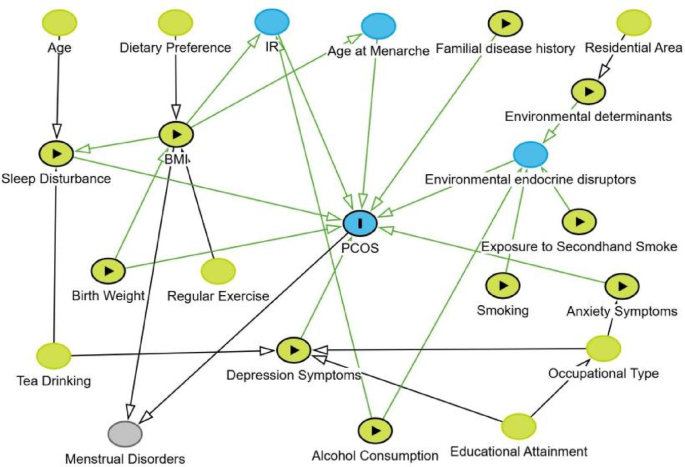
Statistical analyses were conducted using SPSS version 26.0. Normality tests on continuous variables utilized the Shapiro–Wilk test, with appropriate statistical methods applied based on data distribution. Categorical variables were assessed through chi-square tests. Directed Acyclic Graphs (DAGs) played a vital role in identifying causal relationships and guiding variable selection for regression analysis, streamlining the process of discovering relevant factors influencing PCOS.
Conclusion
This study not only aimed to elucidate the characteristics of women diagnosed with PCOS but also provided a framework for understanding the interplay between lifestyle factors and psychological wellness. The findings contribute to the wider body of knowledge regarding PCOS in the context of the Chinese population, informing both clinical practices and future research directions.
