


Many years ago, a personal journey began when I volunteered for a sexual assault hotline. The experience was overwhelming—not only due to the significant number of women and girls who reached out, sharing distressing stories, but also because I realized these individuals were just a small fraction of the countless survivors of sexual violence.
This profound understanding, coupled with my own experiences and admissions from friends, motivated my pursuit of a career in clinical psychology and mental health counseling.
My decision to attend The Graduate School at Northwestern was driven by the institution’s dedication to supporting vulnerable populations—an essential alignment with my career goals of providing therapy and conducting research focused on survivors of sexual violence and exploitation.
However, I have observed an inconsistency between Northwestern’s stated commitment and its curriculum. Specifically, the majority of my intended clientele—women and girls—have been largely absent from our studies.
In a course dedicated to diverse identities, our exploration of gender lasted only one week. While transgender women’s challenges received extensive discussion, the broader category of women was overlooked, including critical issues such as sexual violence and reproductive justice.
The only mention of a feminist perspective arose during a casual comment from our professor, who touched on feminist therapy principles but emphasized that these did not necessarily apply to “women,” placing the term in quotation marks.
In my time at Northwestern, intimate partner violence was discussed minimally, with only two articles assigned—one discussing abuse in lesbian relationships and another inaccurately equating perpetration rates between men and women. There was no acknowledgment of the well-documented prevalence of male violence against women, a topic essential for any clinical training.
The faculty at Northwestern display intelligence and empathy, yet it raises questions about their awareness of current statistics that should inform our training.
Recent data from the CDC highlights a mental health crisis among teenage girls, marked by heightened levels of violence and psychological distress. Furthermore, the conservative estimate that one in six women in the U.S. has experienced sexual violence—and the global statistic of one in three—should be pivotal in clinical education.
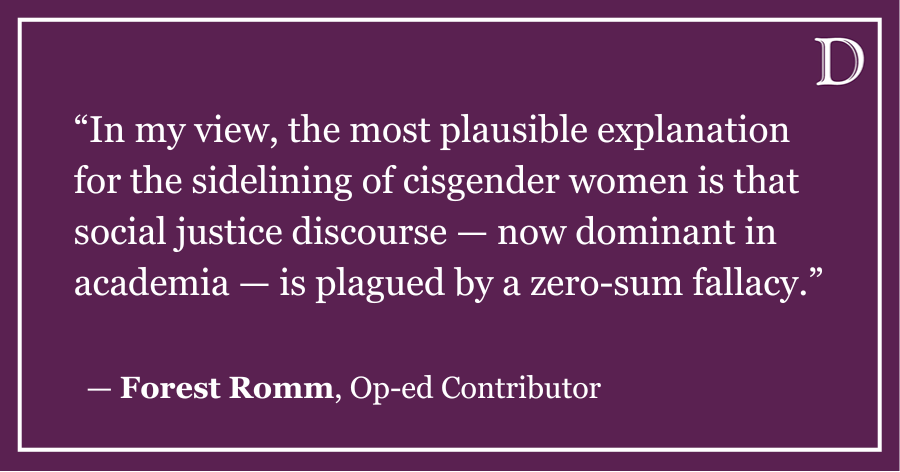
One likely explanation for the omission of cisgender women’s issues may stem from the prevalent social justice dialogue in academia, which often adopts a zero-sum perspective. This ideology suggests that progress made for one group must come at the expense of another.
Such thinking may foster a misconception that addressing issues faced by cisgender women undermines queer advocacy, resulting in the dismissal of feminist concerns, especially regarding the implications of granting access to female spaces based on gender self-identification.
Critically discussing potential risks associated with these policies often leads to accusations of “TERF” bigotry, obscuring the intention behind raising such concerns.
On some level, feminists must recognize our role in this marginalization. Cultural pressures frequently teach women to value kindness and acceptance, sometimes at the expense of advocating for their own rights.
Expectations surrounding the feminist movement, unlike those applied to other political causes, often place societal pressures on cisgender women to elevate others’ agendas above their own.
A feminism that confidently asserts its objectives poses a challenge to traditional notions of femininity and, as a result, may face backlash.
Feminist and queer movements do not benefit from a zero-sum mentality, which only exacerbates existing tensions between them.
Instead of excluding cisgender women in the interest of bolstering queer identities, it is crucial to engage in constructive dialogue that aims to explore the intricate intersections of both experiences. It is possible to acknowledge the areas of commonality and divergence, ultimately fostering support for both groups without compromising either.
This complexity deserves the attention of the intellectual community at Northwestern. A failure to engage adequately risks creating a generation of mental health professionals who are ill-equipped to address the unique needs of cisgender women, who continue to face a persistently high incidence of sexual violence and exploitation.
