


Art as Protest: The Femme Quilting Movement in Mexico
The tragic murder of 25-year-old Ingrid Escamilla in February 2020 shook Mexico, highlighting the pervasive gender-based violence in the country. Escamilla was killed and mutilated by her boyfriend, with graphic images of her body subsequently leaked to the media, sparking widespread outrage.
Artist María Antonieta De la Rosa responded to this violence by recognizing its deeper societal implications. “You realize how permeating this violence is,” she commented, noting the normalization of such brutality in Mexico, where an average of over ten women are killed each day.
The Context of Violence Against Women
Mexico has become infamous for being one of the most perilous places for women, fueled by a combination of machismo culture and cartel-related violence. Official statistics reported that between January and June 2020 alone, 1,420 women were murdered across the nation.
In response to this alarming trend, a robust feminist movement has emerged, with thousands of women rallying annually on International Women’s Day, seeking accountability and action from authorities.
Embroidery as a Form of Resistance
At the time of Escamilla’s death, De la Rosa was pursuing a master’s degree in fine art and had begun exploring embroidery—a traditionally undervalued medium often used by women for protest. To raise awareness about Escamilla and other victims from her home state of Morelos, she collaborated with fellow activists Karime Díaz and Xóchitl Guzmán in early 2020.
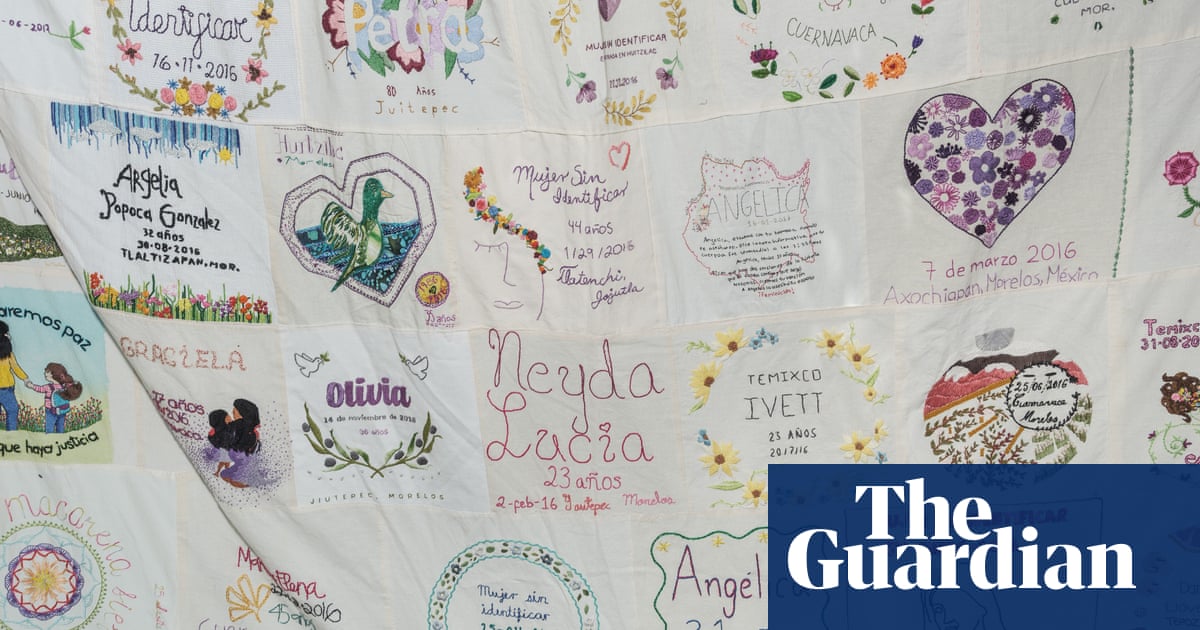
Together with family and friends, they organized a symbolic funeral for Escamilla at a former women’s shelter in Cuernavaca, where they began embroidering patches inscribed with the names of women who had been murdered in the state in previous years.
A Collective Healing Process
Díaz reflected on the emotional complexity of embroidering names of victims, noting, “It was very contradictory to feel so supported but at the same time to share this uncertainty, this pain.” This process is particularly poignant for the women involved, with some finding connections to the names they stitch, underscoring their shared vulnerability.
During protests in March 2020, De la Rosa and her colleagues carried a coffin draped with a quilt embroidered with the names of female victims. The impact was immediate, causing the marchers to fall silent in a powerful acknowledgment of the lives lost.
The Evolution of the Collective
A call was made on social media inviting women to join the initiative, aiming to embroider the names of all femicide victims in Morelos since 2015. Despite pandemic-related restrictions preventing in-person meetings initially, numerous women participated by embroidering patches at home, which were later assembled into a large quilt.
In subsequent gatherings, the founders recognized that for many participants, the act of embroidery could evoke profound emotions. As Guzmán, a trained psychologist, highlighted, “Embroidering is an artistic process that takes time. It’s a very intimate process.” This intimacy required careful consideration and support for participants navigating their grief.
Memorializing Community Loss
In December 2023, the collective faced another devastating blow when fellow artist and activist María Fernanda Rejón was found dead. This tragedy reiterated the looming threat posed by gender-based violence. In a show of solidarity, the group began a new quilt featuring Rejón’s face surrounded by butterflies, which her mother began to carry in feminist marches.
Las Nombramos Bordando (We Name Them by Embroidering) continues to expand, now encompassing contributions from women across various states, collectively embroidering around 200 patches. This growing network includes informal sewing sessions throughout the year in addition to the main annual events.
The Art of Remembering
On a recent sunny morning in Cuernavaca, a group of women, including De la Rosa, Díaz, and Guzmán, gathered to create new artwork for their quilts. The quilts, adorned with names and symbols, may initially appear as beautiful art; however, their true, haunting significance surfaces upon closer inspection.
As Díaz mentioned, “Art allows us to enter people’s lives in a different way, even if it’s a form of protest.” For those involved, this collective action transforms individual names from mere data points into poignant reminders of lost lives.
A Personal Journey Through Activism
Participants like Ana Vázquez, who joined the collective during the pandemic, use embroidery as an avenue for activism, regarding it as a way to confront the pervasive violence they experience. “We’re not going to change the world with this,” she stated, “But at least we’re making noise.”
Yet the process also evokes fear, as expressed by Vázquez, who worries, “I can’t stop thinking that my name is going to be up there some day.” This constant awareness of vulnerability amplifies the urgency behind their artistic and activist efforts.
