


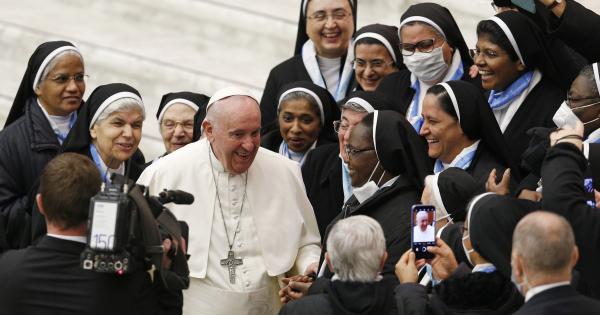
Pope Francis, who played a pivotal role in enhancing the role of women, particularly women religious, within the Catholic Church, passed away on April 21 at the age of 88. Throughout his papacy, which commenced on March 13, 2013, he worked diligently to dismantle clerical structures that had long emphasized the dominance of priests and bishops, thereby limiting the involvement of laity in church governance.
Throughout his tenure, Francis made significant strides by including women in roles traditionally reserved for men. In a notable reform in 2022, he amended the Vatican’s constitution to permit women and laity to hold positions within the Roman Curia. This was exemplified by the historic appointment of Consolata Missionary Sr. Simona Brambilla as prefect of the Dicastery for Institutes of Consecrated Life and Societies of Apostolic Life, marking a significant moment in the Church’s history where women religious would be overseen by a female leader.
Beth Blissman of the Loretto Community emphasized that Francis exemplified the values of Jesus as depicted in the Gospels. The Leadership Conference of Women Religious lauded him for embodying the Gospel’s call to prioritize those in need and advocate for the marginalized, asserting that he represented a Church committed to welcoming and inclusivity.
In a series of groundbreaking appointments, Francis named Xavierian Sr. Nathalie Becquart as undersecretary of the Vatican’s Synod of Bishops office in 2021, making her one of the first women in such a prominent Vatican position. This symbolic gesture underscored a gradual shift towards recognizing the voices of women within church structures.
Additionally, in 2019, he appointed six leaders from international religious orders, alongside a woman leading a consecrated laywomen’s institute, as full members of the Congregation for Institutes of Consecrated Life and Societies of Apostolic Life—an unprecedented move demonstrating commitment to gender inclusivity.
Under his leadership, women were granted new opportunities for participation in synods. In 2023, approximately 50 women were allowed the right to vote at the Synod on Synodality, marking a significant change from their previous roles as observers. This decision promoted equal representation and engagement among participants.
Pope Francis was not just an advocate for women; he also engaged deeply with issues affecting other marginalized groups. His approach included meeting with individuals like Loretto Sr. Jeannine Gramick, who had long been targeted for her work with LGBTQ Catholics. In a letter ahead of their meeting, Francis expressed his understanding of her struggles, stating, “I know how much she has suffered,” characterizing her as a “valiant woman.”
His vocal support for social justice was evident during events such as the 2015 video conference wherein he publicly appreciated Missionaries of Jesus Sr. Norma Pimentel for her dedication to serving immigrants at the US-Mexico border. Francis’ commitment extended to environmental issues as well, encapsulated in his 2015 encyclical, Laudato Si’. This document urged collective action against climate change and inspired many women religious to adopt sustainable practices within their communities.
By 2022, Francis’ influence prompted congregations of women religious in the United States to confront their historical involvement in Native American boarding schools. His apology, made during a visit to Canada, acknowledged the Church’s role in these “catastrophic” institutions, and he requested forgiveness for the “evil committed by so many Christians against the Indigenous peoples.”
Moreover, Francis fostered an open dialogue with women religious leaders by engaging with them in question-and-answer sessions, a shift from traditional hierarchical interactions. In 2016, he sanctioned a study on the potential reinstatement of women deacons, though the commission later disbanded without publishing results.
He gave to the world a public face of a church that was welcoming and inclusive – a church that strove to be a true ‘field hospital.’
Pope Francis, the first Pontiff from Latin America, resonated with the 425 million Catholics in the region. The Confederation of Latin American Religious recognized him as a “brother,” celebrating his efforts to lead them towards a more synodal and mission-focused Church.
His embrace of women religious and commitment to uplifting their contributions have deepened the bonds between the Pontiff and sisters globally, particularly in light of investigations into U.S. congregations that had previously subjected them to scrutiny. His papacy represented a movement towards healing and strengthening the Church’s connection to its devoted members.
In conclusion, Francis’ tenure as Pope was marked by a dedication to inclusivity, dialogue, and progressive reform, transforming the landscape of the Catholic Church by emboldening women religious to fulfill their roles with dignity and purpose.
