


By David Greenham
The CST/Catalyst Collaborative@MIT continues to shine a spotlight on the remarkable stories of women’s contributions to the field of science, with compelling narratives that deserve recognition.
The production of Silent Sky, written by Lauren Gunderson and directed by Sarah Shin, showcases the life of Henrietta Leavitt, a pioneering female astronomer. Featuring choreography by Peter DiMuro, scenic design by Qingan Zhang, and costume design by Leslie Held, this performance is currently being presented at Central Square Theater in Cambridge, running through October 5.
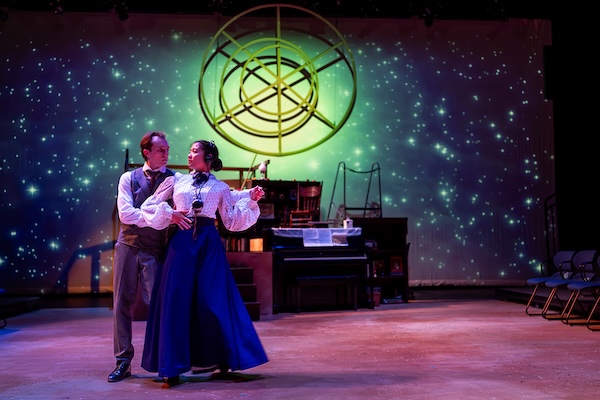
Jenny S. Lee and Max Jackson in the Catalyst Collaborative@MIT production of Silent Sky. Photo: Nile Scott Studios
Set in 1902, the play follows Henrietta Leavitt (depicted by Jenny S. Lee) and her sister Margaret (Kandyce Whittingham) as they navigate societal expectations of women. Their father, a pastor, raises them in Ohio, where their futures appear fixed within traditional caregiving roles. However, Henrietta defies those norms, declaring, “Heaven’s up there, they say,” as she pushes against societal constraints and persuades her father to allow her to pursue a career in astronomy.
Upon moving to Boston, Henrietta encounters Edward Pickering’s assistant, Peter Shaw (Max Jackson). Shockingly, she learns that her anticipated work with the Harvard College Observatory’s renowned refracting telescope is restricted to men. Instead, she joins a team of female ‘computers’ alongside Williamina Fleming (Lee Mikeska Gardner) and Annie Jump Cannon (Erica Cruz Hernández), both formidable figures in their own right. Although they are derisively nicknamed “Pickering’s Harem,” the trio develops camaraderie while tackling the challenges of categorizing stars.
Determined to extend their contributions beyond data entry, Henrietta asserts, “I have some pressing issues with science,” reflecting a quest for deeper understanding about humanity’s place in the cosmos. She embarks on her research, mapping star brightness changes while simultaneously charming Peter, who finds himself captivated by her intellect and spirit.

Kandyce Whittingham and Jenny S. Lee in the Catalyst Collaborative@MIT production of Silent Sky. Photo: Nile Scott Studios
Gunderson expertly interweaves technical scientific exploration with rich personal narratives, portraying the dynamic relationships among the main characters—Henrietta, Annie, and Williamina. Their bond is both supportive and sometimes humorous, reflecting a shared resilience against the institutional sexism of their time.
The interactions between Henrietta and her sister Maggie reveal the depth of familial support, encapsulated in moments of tenderness and tension. Jackson’s portrayal of Peter adds a comic touch as he awkwardly navigates his feelings for Henrietta. As their relationship develops, both characters grapple with communication, emphasizing the uncertainties of love and ambition.
Director Sarah Shin ensures that the pacing of the two-and-a-half-hour performance holds the audience’s attention, aided by an effective set design by Qingan Zhang along with striking lighting by Eduardo M. Ramirez, ethereal sound by Kai Bohlman, and period-appropriate costumes by Leslie Held.
The cast delivers powerful performances, especially Jenny S. Lee, whose portrayal of Henrietta captures both her vivacity and introspective depth. As Williamina and Annie, Gardner and Hernández provide a strong foundation, while Whittingham’s Margaret grounds the family elements of the story.
This production not only highlights Henrietta’s groundbreaking contributions to science but also serves as a pertinent reflection on societal attitudes toward women. In an era where progress in women’s rights feels threatened, Silent Sky emerges as a critical narrative about the necessity of equity and the pursuit of knowledge.
The conclusion of the play resonates deeply, featuring a recitation of Walt Whitman’s poem When I Heard the Learn’d Astronomer, which poignantly underscores the importance of inquiry and understanding, inviting contemplation of our relationship with the universe and the dangers of neglecting scientific exploration.
In essence, this production by the CST/Catalyst Collaborative@MIT encapsulates a timeless message about the contributions of women in science and the ongoing fight against misogyny—a theme that remains as relevant today as it was a century ago.
