


NDA’s Resounding Victory in the 2025 Bihar Assembly Elections
The National Democratic Alliance (NDA) achieved a sweeping victory in the 2025 Bihar Assembly elections, led by Nitish Kumar’s comeback and Prime Minister Narendra Modi’s sustained popularity. Despite the Rashtriya Janata Dal (RJD) securing a significant share of the votes, they finished third in seat numbers.
Election Outcomes
In the election, the NDA dominated by leading in over 200 of the 243 assembly seats. The Bharatiya Janata Party (BJP) emerged as the single-largest party with a lead in 91 seats, while the Janata Dal (United) (JDU) was on track to significantly enhance its representation, leading in 83 seats compared to just 43 in the previous election.
Shifting Social Dynamics
The results highlighted a failure of the Mahagathbandhan (MGB) to expand its social coalition. The return of political figures such as Upendra Kushwaha and Chirag Paswan to the NDA strengthened its overall voting appeal, countering the alliances previously formed by the MGB with the CPI(ML) Liberation party, which traditionally garnered support from Kushwahas and Dalits.
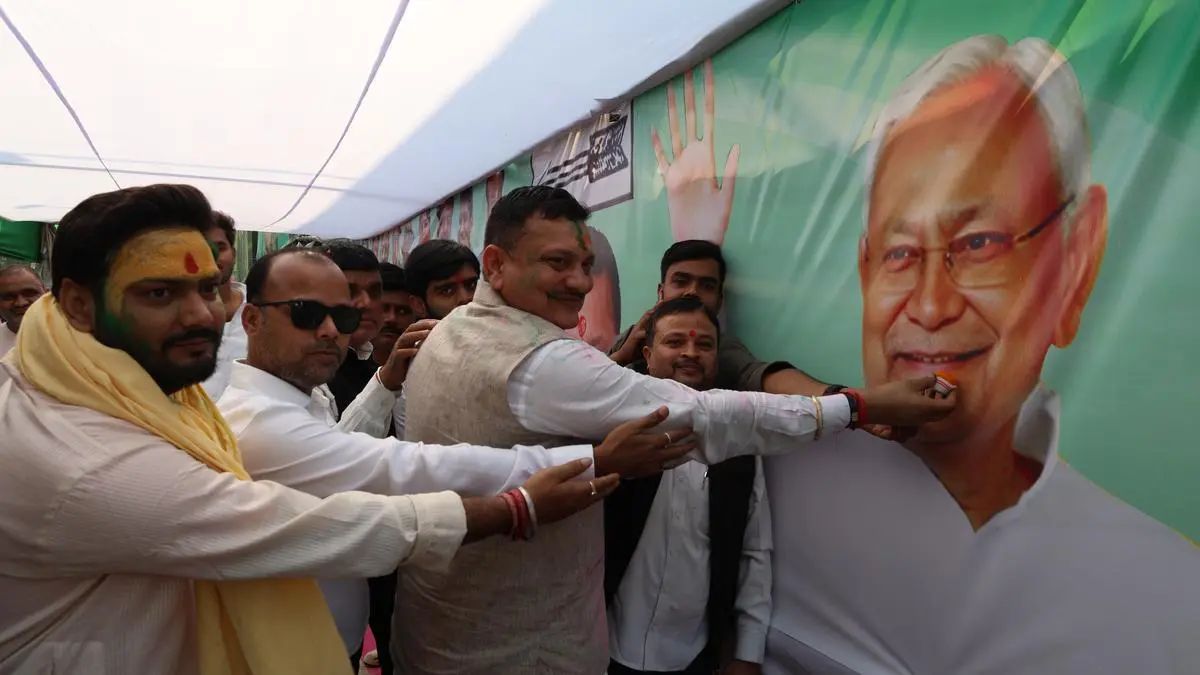
JD(U) worker celebrating at Nitish Kumar’s victory rally in Patna. Nitish Kumar’s welfare initiatives combined with BJP’s organizational strength fortified the NDA, revealing MGB’s limitations in expanding its base.
Women’s Influence on Electoral Success
Nitish Kumar’s administration saw notable success with women voters, buoyed by initiatives such as the Mukhyamantri Mahila Rojgar Yojana, which provided direct cash transfers. Voter turnout among women was impressive, with 71.78% of registered female voters participating, compared to 62.98% of male voters. This trend mirrored recent elections in Madhya Pradesh and Jharkhand, where similar welfare schemes operated favorably for incumbent parties.
Analysis of the Vote Distribution
Within the JDU, women actively participated, evident from gatherings in celebration after the victory. BJP leaders suggested that the MGB’s leadership failed to present a credible alternative, leading to their electoral defeat. The NDA’s performance not only surpassed their expectations from the previous Lok Sabha elections but also indicated a substantial consolidation of support.
RJD’s Electoral Struggles
The RJD encountered hurdles, particularly in failing to broaden its support base beyond the traditional Muslim-Yadav (MY) coalition. Intermediary backward classes did not unify, while challenges from Asaduddin Owaisi’s political maneuvering in areas like Seemanchal further impeded RJD’s prospects. In addition, public dissatisfaction was noted regarding the RJD’s choice of candidate for Deputy Chief Minister, signaling issues within their strategy.
Impact of Hindutva Politics
Though the landscape of Bihar politics differs from regions like Uttar Pradesh, the influence of Hindutva politics is increasingly felt, with the BJP gaining ground among various social groups. The Congress party’s performance was notably lacking, securing leads in fewer than five seats, raising questions about its future alignment with the RJD. Calls for the Congress to operate independently from regional parties emerged, showcasing deeper challenges ahead.
Emerging Challenges and Future Directions
The results of this election reflect a preference among Bihar voters for stability and continuity over experimental changes. Nitish Kumar’s visible development contributions, including infrastructure and social welfare, outweighed calls for disruptive transformations, despite concerns over unemployment and slow economic growth raised by the opposition.
Conclusion
The 2025 Bihar Assembly elections underscored the complexity of caste dynamics and voter motivations within the state. Despite the setbacks faced by various parties, particularly the RJD and Congress, the NDA’s harmonious blend of welfare initiatives and traditional support networks positioned it strongly for the future. As regional dynamics shift, the political landscape will require adaptive strategies to respond to an evolving electorate.
