


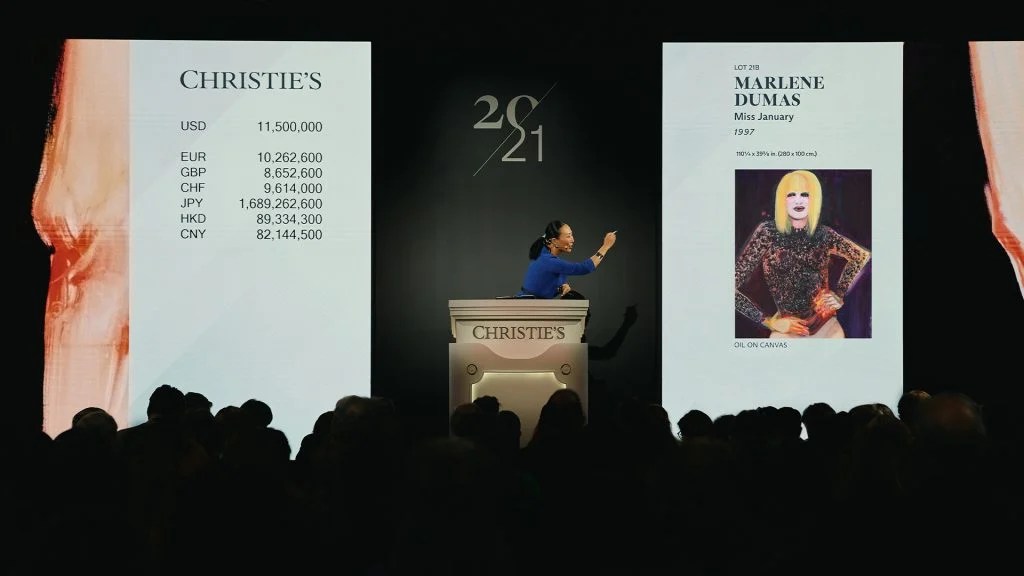
Marlene Dumas recently attained the title of the most expensive living female artist after her 1997 painting, Miss January, fetched $13.6 million at a Christie’s auction on Wednesday night. This sale highlights a significant moment for female artists in the auction scene, despite the work being accompanied by a third-party guarantee and effectively pre-sold. Still, it’s a noteworthy accomplishment from various perspectives.
Market Context and Comparisons
However, when examining broader market dynamics, Miss January did not hold the top spot at the auction. That distinction belonged to Jean-Michel Basquiat, whose 1982 painting Baby Boom sold for $23.4 million. To put this in perspective, the value of a single Baby Boom is almost double that of a Miss January. Additionally, Basquiat’s earlier works show even more staggering figures; a skull painting from 1982 sold for $110.5 million in 2017.
In the context of this week’s auctions in New York, Dumas’s painting holds the record for the highest price for a work by a woman, living or deceased. The major auction houses—Christie’s, Sotheby’s, and Phillips—are showcasing their finest works as part of their May marquee auctions, events closely monitored by art market participants, including collectors and dealers.
Yet, in terms of auction results, Dumas’s piece did not even break into the top five of the week’s highest sales, which were all attributed to male artists: Claude Monet, Pablo Picasso, Alberto Giacometti, René Magritte, and Piet Mondrian, whose painting Composition with Large Red Plane, Bluish Gray, Yellow, Black and Blue sold for $47.6 million, just short of his auction record.
Broader Implications for Women in Art
Such comparisons illuminate an ongoing challenge: artworks by deceased male artists tend to command higher prices. Examining records set by other living male artists, such as Damien Hirst’s $19.2 million and Christopher Wool’s $29.9 million, underscores the persistent gap—none of these works achieved near Dumas’s latest auction figure, although the disparity remains significant.
Other women artists also achieved notable sales: Simone Leigh’s sculpture brought in $5.7 million, while Emma McIntyre’s painting sold for $201,000. However, these figures still fall short when contextualized against the highest-selling pieces like those by Mondrian or Picasso, reflecting the barriers women artists face in the auction world.
Dumas’s oeuvre, characterized by complex themes, raises questions about appropriation and voyeurism. Miss January was inspired by images from adult magazines, and Dumas has discussed her unconventional approaches in interviews. “Why do I use source materials from porno books as models for my figures if it’s not the pornographic that I’m after? Because I can’t see myself when I do the things I do,” she explained in a 2008 audio tour at MoMA.
Implications for the Art Market
While Miss January carries conceptual weight, its auction performance was comparatively muted, with just a minute of bidding. The work missed its high estimate of $18 million and generated commentary that reflected a lack of excitement surrounding the sale.
Despite the significant sale, the disparity in auction prices demonstrates a larger narrative about how the art world perceives value. Auction success directly influences visibility for artists, fostering opportunities in galleries and museums. Increased auction prices may also elevate retail prices at art fairs, which, in turn, can benefit the artists involved.
Nevertheless, there are encouraging signs of progress. Recent sales have shown substantial gains for artists like Olga de Amaral, whose piece surpassed previous records by more than $400,000. Additionally, forthcoming auctions are anticipated to set further records for other women artists, demonstrating a shift in market dynamics.
Art markets have evolved substantially over the years. In a survey conducted in 2014, no living female artist ranked among the top ten most expensive auction sales, while today’s landscape reflects a growing recognition of their contributions. However, the slow pace of change remains evident, highlighting the systemic barriers still prevalent in the industry.
