


By Orna Coussin
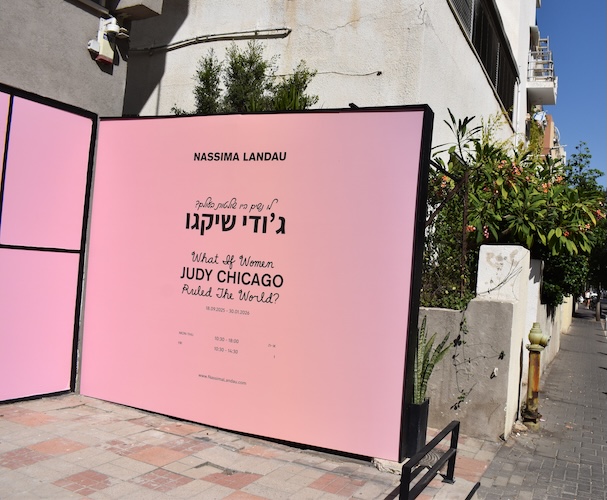
Judy Chicago’s exhibition, What If Women Ruled the World, opened in Tel Aviv at the end of September 2025, featuring two simultaneous venues: the Tel Aviv Museum of Art and the Nassima Landau Gallery. This event is significant not only for its artistic contribution but also for its socio-political commentary set against the backdrop of ongoing violence in Gaza, where a grim humanitarian crisis has persisted since October 2023.
The exhibition reflects on the stark inequalities of power, as men predominantly control political and military decisions. In a poignant response, prominent Israeli artists, including Guy Ben Ner, appealed to Chicago to cancel the exhibition, arguing that it perpetuates institutions complicit in the violence against Palestinians. This call stems from a deep concern for the lives shattered by conflict and a desire for global support that may compel Israel to reassess its actions.
Despite aligning with the sentiment calling for a boycott, I find significant value in Chicago’s exhibition. As a teacher of critical writing at the Bezalel Academy of Arts and Design in Jerusalem, I see it as a crucial tool for encouraging vital discourse among students. Although the initial strategy may have been to boycott, the lessons Chicago presents resonate long-term, prompting necessary reflections on violence and governance.
The exhibition features a large quilt that visually and textually connects diverse perspectives on a world led by women, incorporating thought-provoking responses to the question posed in its title. Accompanying this quilt is a video dialogue between Chicago and Nadya Tolokonnikova, co-founder of Pussy Riot, exploring their motivations and shared insights. Interestingly, a booth allows visitors to contemplate and respond to the central question, though it remains unclear how these interactions will be recorded.
While the Tel Aviv Museum offers a fragmented representation of Chicago’s work, the Nassima Landau Gallery showcases her artistry in full, presenting a broader scope of Chicago’s career, including notable pieces like The Dinner Party, which honors historical female figures through a unique installation. This gallery not only celebrates her contributions but also invites deeper engagement and understanding of feminist art in today’s context.
As the exhibition progresses, it raises an essential inquiry: what would governance look like under female leadership in Israel and Gaza? Historically, even discussions about female leadership are tinged with skepticism, particularly from those who cite examples of women in power who engage in destructive politics. This skepticism reflects a deeper struggle within gender discussions, illustrating how patriarchal narratives endure even in feminist dialogues.
The quilt within the exhibition contains inspiring and varied responses: “We would instill much more gentleness and empathy among beings,” and “If women ruled the world, we wouldn’t invade countries and kill mothers and children.” Such responses suggest that a reimagined form of leadership could herald not only a shift in governance but a transformation in values—lessons I am eager to impart to my students.
Chicago’s exploration transcends mere equality; it aims for a post-patriarchal vision. She posits a framework where various genders collaborate for the betterment of society, negating the historically glorified ideals of nationalism and conquest that have precipitated violence. This perspective challenges the status quo of how we perceive leadership, urging a reevaluation of core societal values.
In teaching these ideas, I strive to encourage students to arrive at their own conclusions regarding the potential for a world reshaped by diverse forms of leadership. The urgency of the current socio-political landscape leaves one to wonder which will first face collapse: the established state of Israel or the patriarchal systems that govern many aspects of life. Regardless, there is a necessity to dream and draft alternatives for a more just and equitable future.
Orna Coussin, originally from Scotland, is a writer, essayist, and mentor based in Tel Aviv. She has published ten books in Hebrew and received notable awards, including the Prime Minister’s Prize for Hebrew Literary Works and an Excellence in Teaching Award at the Bezalel Academy of Arts and Design.
