



Breast cancer remains a critical health issue impacting women worldwide, yet significant disparities exist in survival rates, particularly between Black and white women. While the overall incidence of breast cancer is approximately 5 percent lower among Black women, they experience a striking 38 percent higher mortality rate, as indicated by the American Cancer Society.
This ongoing issue has prompted extensive research, leading to a recent analysis from Susan G. Komen, which reveals nuanced progress in closing the mortality gap. The nonprofit organization studied key metropolitan areas and found declines in mortality rates for Black women across nearly all regions assessed, with only one exception noted.
Analysis of Recent Findings
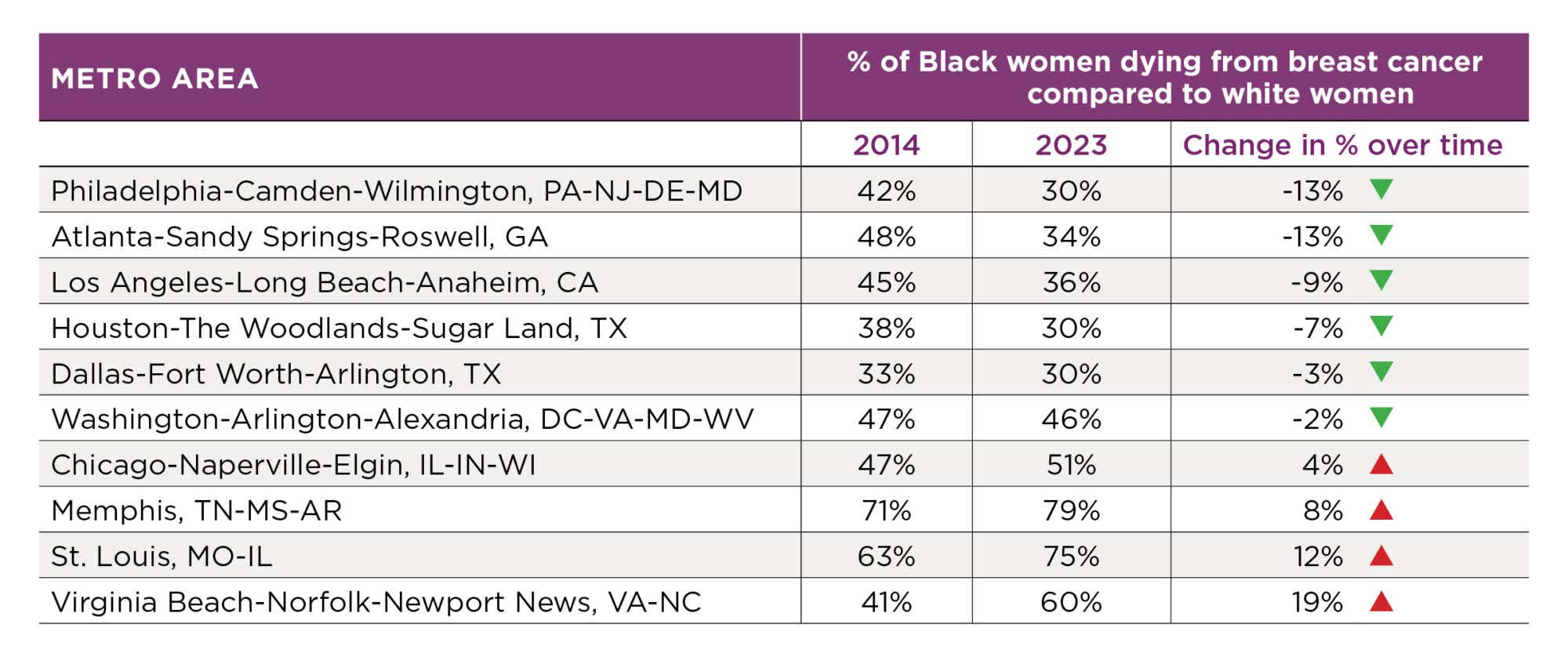
The report, set to be released in conjunction with Breast Cancer Awareness Month, focuses on metropolitan areas known for substantial disparities in late-stage diagnoses and mortality rates, including Atlanta, Chicago, Dallas, Houston, Los Angeles, Memphis, Philadelphia, St. Louis, Virginia Beach, and Washington, D.C.
Notably, mortality rates for Black women decreased significantly in areas such as Virginia Beach and Philadelphia, with declines of 21 and 16 percent, respectively. Conversely, other locations like St. Louis and Memphis saw minimal improvements of 1.6 and 2.3 percent, while Dallas experienced an uptick of 2.7 percent in mortality rates.
Despite these improvements, the data indicates that progress toward parity remains uneven. In four metropolitan areas—including Chicago, Memphis, St. Louis, and Virginia Beach—the gap in mortality rates between Black women and their white counterparts has actually widened. For instance, in Virginia Beach, the disparity has increased from a 41 percent higher likelihood of death among Black women in 2014 to 60 percent in 2023.
As noted by Sonja Hughes, MD, vice president of community health at Susan G. Komen, “We’re seeing some improvement, but not across the board.”
Understanding the Risk Factors
The reasons behind higher breast cancer mortality rates among Black women are multifaceted. Natasha Mmeje, the director of community health and outreach at Susan G. Komen, identifies significant barriers to quality healthcare access. These barriers may include longer distances to accredited medical facilities and a higher likelihood of lacking health insurance.
Moreover, systemic issues are exacerbating these disparities. For instance, recent declines in Medicaid coverage in Texas have resulted in fewer women receiving necessary mammograms. Mmeje indicates, “People are still seeking care much later, when they’ve already found a lump,” which complicates treatment efforts when cancer has progressed.
Efforts to Address the Disparity
To combat these disparities, collaborative initiatives are emerging. Experts emphasize the value of forming coalitions that unite organizations like Komen with local hospitals and community groups. Lorna McNeill, PhD, from the University of Texas MD Anderson Cancer Center, highlights the effectiveness of programs that leverage trusted community networks. An initiative like the Worship in Pink program focuses on educating Black congregations about the importance of early detection.
Moreover, Susan G. Komen is actively enhancing access to genetic testing, particularly in areas where Black women disproportionately develop aggressive forms of breast cancer, such as triple-negative breast cancer. Collaborations with institutions like MD Anderson in Houston and Penn Medicine in Philadelphia aim to provide vital genetic counseling and support for women at higher risk.
As Dr. Hughes concludes, “This shows that progress is possible, but there’s still more work to be done.”
