

Close Menu
EmpresernceMag
  • News
  • Money
    • Business and Market Watch
  • Career
  • Politics
  • Health/Wellness
    • Fitness
  • Sports
  • Science/Tech
  • State of Women
  • Relationships

Subscribe to Updates

Get the latest creative news from FooBar about art, design and business.

What's Hot

AIP.org Highlights from October 24, 2025

December 1, 2025

Women’s Basketball Undefeated at 8-0 After Dominating Penn 81-63

November 30, 2025

UConn Faces Off Against Xavier: Big East Women’s Showdown on FOX Sports

November 30, 2025
Facebook X (Twitter) Instagram
Facebook X (Twitter) Instagram Vimeo
EmpresernceMag
Login
  • News
  • Money
    • Business and Market Watch
  • Career
  • Politics
  • Health/Wellness
    • Fitness
  • Sports
  • Science/Tech
  • State of Women
  • Relationships
EmpresernceMag
  • News
  • Money
  • Career
  • Politics
  • Health/Wellness
  • Sports
  • Science/Tech
  • State of Women
  • Relationships
Home » Enhancing Women’s Representation in STIP Through Machine Learning Insights
Science/Tech

Enhancing Women’s Representation in STIP Through Machine Learning Insights

Trisha GonzalesBy Trisha GonzalesSeptember 1, 2025No Comments3 Mins Read
Facebook Twitter Pinterest LinkedIn Tumblr WhatsApp VKontakte Email
Enhancing women's representation in stip through machine learning insights
Share
Facebook Twitter LinkedIn Pinterest Email

Machine Learning Analysis of Women’s Representation in Science, Technology, Innovation, and Policy (STIP)

Introduction

This article delves into a comprehensive study that utilizes machine learning to examine the representation of women in STIP across 60 countries. By analyzing a carefully curated small dataset, which includes five numerical features and one categorical feature, the research highlights patterns in this critical domain.

Methodology Overview

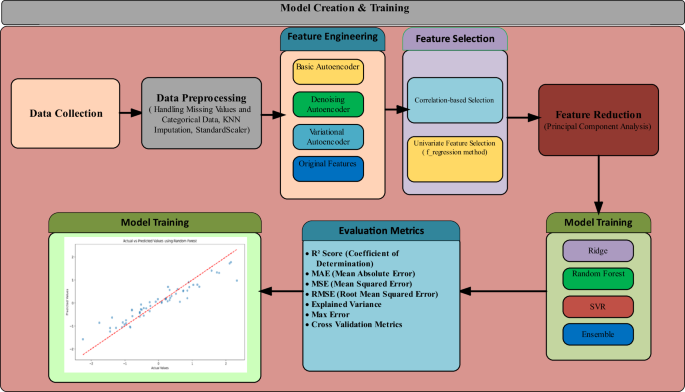
The research implemented a supervised regression model where the dependent variable was the Percentage of Women in STIP (PWS). To tackle missing data—1.70% for STEM degrees and 33.30% for business degrees—KNN imputation was employed.

Feature Engineering

A significant aspect of the study was feature engineering, which involved three autoencoder variants: basic, variational, and denoising. This process expanded the dataset from its original dimensions to 27 columns. A rigorous feature selection approach combined methods such as Random Forest Feature Importance, LASSO regression, and Sequential Feature Selection to pinpoint influential predictors.

Dimensionality Reduction Techniques

The research employed dimensionality reduction techniques, including correlation analysis and Principal Component Analysis (PCA) with 95% variance retention, effectively minimizing data noise while retaining essential information.

Model Evaluation and Sensitivity Analysis

The experimental design consisted of evaluating numerous regression models, including Ridge Regression, SVR, Linear Regression, ElasticNet, and Lasso. Each model underwent 10-fold cross-validation to ensure robust evaluation and hyperparameter optimization via GridSearchCV.

Performance Metrics

Multiple metrics such as R², mean cross-validation standard deviation, Mean Absolute Error (MAE), and Root Mean Squared Error (RMSE) were utilized to assess model efficiency. The study employed statistical analyses to explore relationships between diversity quotas and women’s representation in STEM and policymaking, bolstered by outlier analysis for additional robustness.

Data Collection and Sources

The dataset encompassed metrics pertinent to women’s participation in various sectors, focusing on Women in STEM Percentage (WSP), Women in Policymaking (WP), and Diversity and Inclusion Quota Systems (DIQS). Data was meticulously gathered from reliable organizations such as UNESCO, The World Bank, UN Women, and OECD, spanning from the 1980s to 2024.

Machine Learning’s Role in Social Sciences

The application of machine learning is reshaping social sciences, aiding in recognizing complex patterns and facilitating informed policy-making. This study underscores the synergy between human expertise and machine learning capabilities, particularly in understanding gender disparities in STIP.

The Role of Institutional Theory

By focusing on institutional mechanisms rather than individual behaviors, this research draws on institutional theory to scrutinize how gender disparities are sustained within formal and informal institutions, even in the face of equality policies.

Research Questions Addressed

The research aimed to answer two pivotal questions: firstly, it evaluated the predictive accuracy of machine learning models on the percentage of women in STIP while accounting for domestic data gaps. Secondly, it investigated the impact of Diversity and Inclusion Quota Systems on boosting female representation in STIP sectors.

Concluding Insights

This study adopts a structured methodology leveraging machine learning to untangle the complexities surrounding gender representation in STIP. By meticulously designing a comprehensive framework for data analysis and model validation, the work contributes to understanding how diversity initiatives can effectively enhance women’s participation in these fields.

All statistical information presented is derived from reputable sources, ensuring the accuracy and reliability of the findings.

Enhancing Insights Learning Machine Representation STIP Womens
Share. Facebook Twitter Pinterest LinkedIn Tumblr WhatsApp Email
Previous ArticleWomen’s Soccer Aims for MEC Tournament in 2025
Next Article Empowering Voices: Sumitra Mahajan’s Bold Fight Against Misogyny in Politics
Trisha
Trisha Gonzales

Related Posts

AIP.org Highlights from October 24, 2025

December 1, 2025

Women’s Basketball Undefeated at 8-0 After Dominating Penn 81-63

November 30, 2025

Women Shaping the Future of Science

November 30, 2025

Pioneering Women’s Sports Management Graduate Program at Simmons University

November 30, 2025
Top Articles

Empowering Women’s Health: Embracing Influencers, Apps, and Entrepreneurs for Solutions

November 28, 2025

Understanding Partner Preferences Beyond Appearance

November 29, 2025

Power Women of the East End Dazzle in Southampton

September 11, 2025

AIP.org Highlights from October 24, 2025

December 1, 2025
Don't Miss
Science/Tech

AIP.org Highlights from October 24, 2025

By Trisha GonzalesDecember 1, 20250

In Memoriam: Margaret Walsh Rossiter August 3 marked the passing of Prof. Margaret Rossiter, a…

Women’s Basketball Undefeated at 8-0 After Dominating Penn 81-63

November 30, 2025

UConn Faces Off Against Xavier: Big East Women’s Showdown on FOX Sports

November 30, 2025

Bryant Suffers First Season Loss at PC Road Match

November 30, 2025

Subscribe to Updates

Subscribe to our newsletter and stay updated with the latest news and exclusive offers.

About Us
About Us

Welcome to Empresence Mag, a news and lifestyle destination created to empower, inform, and inspire women around the world. Our mission is to provide a platform that highlights the stories, insights, and issues that matter most to women today.

Don't Miss

AIP.org Highlights from October 24, 2025

December 1, 2025

Women’s Basketball Undefeated at 8-0 After Dominating Penn 81-63

November 30, 2025

UConn Faces Off Against Xavier: Big East Women’s Showdown on FOX Sports

November 30, 2025
New Comments
    Facebook X (Twitter) Instagram Pinterest
    • About Us
    • Contact Us
    • Privacy Policy
    • Terms and Conditions
    • Disclaimer
    © 2026 EmpresenceMag. All Rights Reserved.

    Type above and press Enter to search. Press Esc to cancel.

    Sign In or Register

    Welcome Back!

    Login to your account below.

    Lost password?