


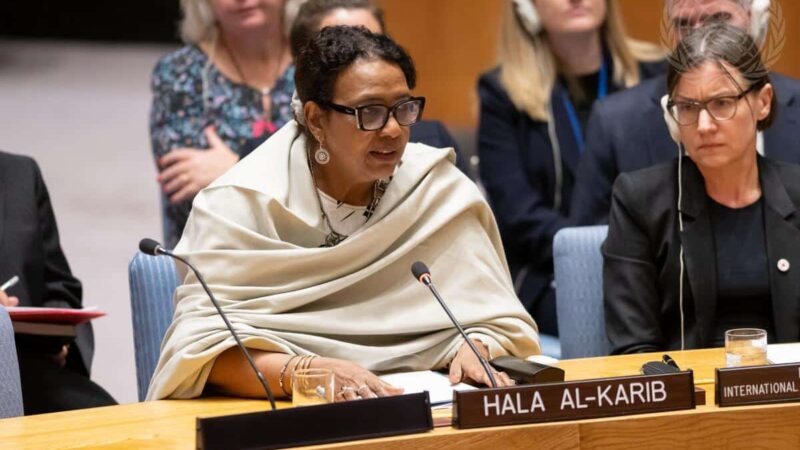

Hala Al Karib at the UN Security Council Open Debate on Women, Peace and Security.
Photo by Forus, used with permission.
By Clarisse Sih and Bibbi Abruzzini
For over three decades, women in the Horn of Africa have been champions of the fight against violence, discrimination, and systemic oppression. A notable figure in this movement is Hala Al-Karib, a Sudanese activist who currently serves as the regional director of the Strategic Initiative for Women in the Horn of Africa (SIHA).
At the core of Al-Karib’s mission is a compelling belief: “We are not just imagining power. We are claiming it.” This perspective is pivotal as she emphasizes the challenges faced by women and the powerful grassroots feminist movements that are shaping the future.
Background of Struggle and Resistance
Al-Karib’s activism is deeply rooted in her experiences growing up in Sudan, where she observed stark inequalities and ethnic tensions that perpetuated oppression. Inspired by the resilience of the women surrounding her, she notes:
I learned early on that oppression exists in many forms—against women, against marginalized communities, against those who challenge power. And I also learned that to survive, we must resist.
Her journey through various countries, including South Sudan, Canada, Egypt, and Uganda, has provided her with a comprehensive understanding of interconnected struggles across borders. In her view, “Audre Lorde said, ‘There is no hierarchy in oppression.’ My activism is rooted in this belief. Whether it’s gender-based violence, ethnic discrimination, or economic marginalization, our fights are linked.”
Current Landscape: Women’s Rights Under Siege
The Horn of Africa is currently experiencing a critical crisis concerning women’s rights. The ongoing war in Sudan has undermined years of advancement, placing women in dangerously vulnerable positions, subjected to unprecedented violence and exploitation.
“Despite their leading role in overthrowing a dictatorship, Sudanese women are now facing a brutal backlash. The level of sexual violence, repression, and femicide is horrifying,” Al-Karib states. Similarly, Ethiopian women have been deeply affected by the chaos following the conflict in Tigray, leading to many survivors of war-related sexual violence seeking justice amid pervasive obstacles.
“Wars disintegrate women’s movements. We build and rebuild, only to see our efforts shattered. But despite this, women keep pushing back, finding new ways to fight,” she emphasizes, highlighting the resilience of women across the region as they confront forced marriages, child labor, and inadequate social protections.
“The world must understand that gender justice is not separate from peace and security—it is at the core of it,” Al-Karib insists.
The Importance of Grassroots Advocacy
For both Al-Karib and SIHA, the quest for gender justice must commence at the grassroots level. She argues:
Real change does not happen only at the top. It happens in student unions, in cooperatives of street vendors, in women-led local governance structures. This is where power is truly reimagined.
Through collaboration with over 200 grassroots organizations, SIHA empowers women across the Horn of Africa to assume leadership roles in areas of justice, economic rights, and social protections. Al-Karib warns against the depoliticization of feminist movements and emphasizes the significance of ensuring that local women’s voices are prioritized over externally imposed agendas.
We cannot be subcontractors in our own fight. We own our realities, and we must define the solutions.
A Call to Action: Collective Strength and Resilience
Upon reflecting on her motivation amid adversity, Al-Karib cites sisterhood as a central source of strength, stating, “What keeps me going is the power of women. Despite everything, we find ways to support each other, to organize, to rebuild. That’s our greatest strength.”
Her message for young feminists is clear: “Find each other. That is how movements are built. That is how we win.”
Hala Al-Karib’s insights serve as a reminder that gender justice is not merely a privilege but a vital fight and responsibility that belongs to everyone.
This narrative is part of the #MarchWithUs campaign, showcasing stories from activists working towards gender justice worldwide. To explore more about Hala Al-Karib, listen to her featured podcast episode.
