


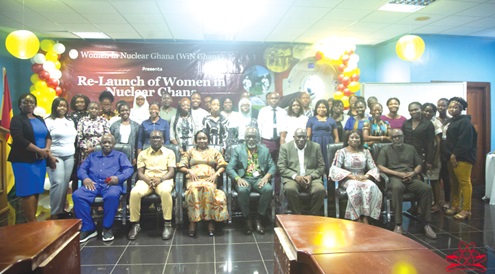
Revitalization of Women in Nuclear Ghana Aimed at Enhancing Women’s Empowerment
The Women in Nuclear Ghana (WiN Ghana) chapter has been revitalized with a focus on empowering female professionals in nuclear science, an essential component for Ghana’s socio-economic progress. The re-launch event, themed “Women in Nuclear Ghana: Strengthening the role women play in nuclear science for the socio-economic development of Ghana,” took place in Accra.
Challenges and Commitment
Initially launched in 2020 amidst the COVID-19 pandemic with a modest membership of six executives and 50 members, WiN Ghana encountered various challenges early in its existence. The current re-launch marks a fresh start aimed at fostering meaningful initiatives.
Strategic Importance of WiN Ghana
Suweibatu Adams, Chief Director of the Ministry of Environment, Science and Technology, emphasized the necessity of revitalizing WiN Ghana for national advancement. She pointed out, “Nuclear science is a catalyst for development in energy, health and agriculture, yet women remain underrepresented due to systemic barriers such as gender bias and limited mentorship.”
Adams noted that, despite the Ghana Atomic Energy Commission (GAEC) employing over 250 women, less than 25 percent hold technical roles, with a significant deficit in leadership positions, despite the training of around 150 women at the MPhil level and seven at the PhD level since 2006.
Advocacy for STEM Education and Supportive Policies
Ms. Adams called for enhanced STEM education initiatives aimed at secondary school girls, equitable hiring practices, and fair promotional processes devoid of gender bias. She highlighted the importance of mentorship, leadership programs, and work-life policies that include flexible working hours and childcare support.
She also referenced the upcoming Affirmative Action Gender Equality Bill (2024), which aims for 30 percent female representation in leadership roles by 2030, along with the Science, Technology and Innovation Policy as significant enablers for change.
Addressing Underrepresentation
Prof. Samuel Boakye Dampare, Director-General of GAEC, underscored the urgent need to address the gender disparities within nuclear science careers, framing the event as a revitalization rather than just a re-launch. He announced that Prof. Mary Adu-Poku would lead mentorship initiatives as part of an effort to combat imposter syndrome among women professionals.
“We need women not only in laboratories but also at the decision-making table,” Dampare urged. He elaborated on the importance of building networks, promoting nuclear science literacy, and forming partnerships with WiN Global and other African chapters.
He commemorated influential women in the field, such as Prof. Aba Bentil Andam, a physics educator known for mentoring future scientists, and Prof. Victoria Appiah, the first female Deputy Director-General of GAEC.
Outlook for Women in Nuclear Ghana
In her remarks, Prof. Mary Adu-Poku, who presides over WiN Ghana and led the event’s organization, expressed optimism that the re-launch would reignite efforts to promote women’s empowerment, crucial for spurring socio-economic development in Ghana.
