


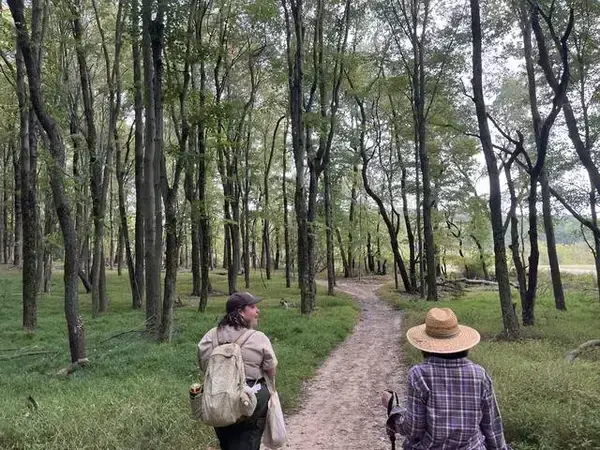
On a pleasant Saturday in Hartwood Acres Park, a hiking event showcased the contributions of notable women in conservation. Participants embarked on a 2-mile guided trek led by Allegheny County park rangers, delving into the legacies of seven inspirational figures who shaped the natural landscape.
The guided hike, titled “Women in Conservation,” was well-attended and made more dynamic by the unique perspectives of different rangers. Ranger Megan Gauger collaborated with Rangers Tyler Loper and Jakob Furge to craft a route that highlighted the stories of these influential women.
At the first stop, Ranger Loper spoke about Rachel Carson, a prominent local conservationist after whom the Ninth Street Bridge is named. “She wrote three books, but ‘Silent Spring’ was one of her most popular and it brought attention to, especially, DDT and other pesticides,” Loper shared. His emphasis underscored Carson’s instrumental role in promoting the cautious use of pesticides.
Continuing the hike, Gauger drew attention to Carol R. Brown and Caren Glotfelty, both of whom have deep connections to Hartwood. Brown, revered for her leadership as director of Allegheny County’s Bureau of Cultural Programs, was pivotal in establishing the park’s sculpture garden and amphitheater. “The sculpture garden has inspired a lot of interest in the park as a whole,” Gauger noted, highlighting the cultural significance of these additions.
At Glotfelty’s namesake wildflower meadow, Gauger explained her contributions as the former executive director of the Allegheny County Parks Foundation. Thanks to Glotfelty’s collaboration with the Audubon Society, 100 chimney swift towers were erected, making the region one of the most significant habitats for these birds in the United States. “Chimney swift towers help to support the population of chimney swift birds that can really only nest in chimney towers,” she added.
The hike included interactive learning, particularly during the segment dedicated to scientist Ruth Patrick. Celebrated for her advocacy against water pollution, Patrick played a crucial role in developing the Clean Water Act. Ranger Loper introduced the “Patrick Principle,” a method for gauging water quality by assessing species diversity within an aquatic ecosystem. “If we go in and flip some rocks and find a nice diversity,” he explained, “we know the stream is going to be pretty healthy.”
Participants engaged with the environment, discovering various aquatic life, including frogs, crawfish, mayflies, and an impressive find of two rare water-penny beetles. Loper expressed his excitement, stating, “This single rock just proved to us that we’ve got a healthy stream.”
Attendee Nancy King, a resident of Plum, discovered the hike through the Cooper-Siegel Community Library’s website. “If you’re interested in learning about the history of women in preservation of forestry, which I thought was fantastic. And then it said, ‘hike,’” King recounted, reflecting on her enthusiasm for the opportunity.
Another hiker, Annamarie Crelli, expressed her long-standing affection for Hartwood Acres Park, stating, “It’s probably my favorite county park. I think we’re lucky to have all these assets really close and convenient to everybody.”
