


Indigenous Women in Odisha Advocate for Climate-Resilience through Community Mapping
In the tribal areas of Odisha, India, a critical movement is emerging among Indigenous villagers as they celebrate an annual harvest festival by gathering fish and eels from local streams. This tradition faces significant challenges, with diminishing resources exacerbated by erratic climate conditions.
Impact of Climate Change on Indigenous Livelihoods
Sunita Muduli, a member of the Paraja tribe from Putpondi village, highlighted the detrimental effects of climate change on local agriculture. “Nowadays, the rains come late, affecting our farming and leading to a decrease in production,” she noted, standing in fields ready for millet planting ahead of the increasingly unpredictable monsoon season.
The Indigenous Adivasis have called these villages home for centuries, but their traditional methods of cultivating millet and rice, as well as foraging for forest produce, are increasingly at risk due to climate shifts. In response, they are actively advocating for the protection and restoration of their lands as India confronts the realities of a warming planet.
Women Leading the Charge
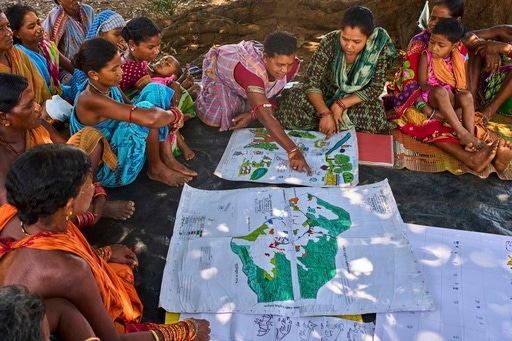
This grassroots initiative is spearheaded by local women who are collaborating with a nonprofit organization to identify dwindling natural resources and areas that require restoration. They have created detailed maps, termed “dream maps,” which illustrate their visions for revitalized communities, prominently featuring vibrant greens to symbolize health and abundance.
Muduli, along with nine other villages, is preparing to present these findings to local government officials, marking an essential step towards securing funding for community development. They estimate that around $2 million will be needed for their efforts, a challenging target considering the economic landscape of India’s poorer regions.
Despite these hurdles, Muduli expressed optimism about their prospects, stating, “We want to make sure these resources are available for our children.”
Uncovering the Scale of Resource Depletion
Women involved in the project have compared current resource availability to data from the 1960s, revealing that common area sizes in their villages have diminished by as much as 25%. Saita Dhangada Majhi of Pangan Pani village emphasized the importance of their forests: “Our forest contains an abundance of diverse resources. However, rainfall has reduced, temperatures have risen, and our forest cover has dwindled.”
They seek rights over their communal lands, establishing a requirement for any external party, including government authorities, to secure the community’s permission before implementing changes.
Statistics on Vulnerability
India ranks as one of the nations most vulnerable to climate impacts, facing extreme weather events such as floods and heatwaves. Between 1993 and 2022, these phenomena resulted in approximately 80,000 fatalities and economic losses approaching $180 billion, according to the 2025 Climate Risk Index. Within this context, Odisha is categorized as one of the poorest states, greatly affected by climate change, with food production decreasing by 40% over the last half-century according to researchers from Fakir Mohan University.
The Role of Indigenous Knowledge
Many farmers in India rely heavily on rain-fed agriculture, which is threatened by unpredictable monsoon patterns that directly impact their livelihoods. Indigenous communities bear a disproportionate burden of climate change, facing existential threats as their traditional lifestyles are intricately woven into the health of natural environments.
Bidyut Mohanty from the nonprofit Society for Promotion of Rural Education and Development highlighted that Indigenous people have not contributed to climate issues, yet they suffer significantly from its impacts. “The forest commons are not only considered the lungs; they are also a hidden kitchen for Indigenous communities,” he stated.
Recognition of Women’s Leadership
The critical work undertaken by Indigenous women in Odisha is drawing attention, with experts noting their pioneering role in climate advocacy. Neha Saigal, a gender and climate expert, remarked, “They are actually leading from the front,” pointing to how their efforts could significantly influence India’s national adaptation strategies.
While it remains uncertain whether these dream maps will be integrated into national climate plans, their creators assert that the process has imparted a formal understanding of the insights they have long possessed.
Ultimately, their goal is clear: to protect the resources and knowledge vital for future generations. “Forest is our life,” Purnima Sisa of Badakichab village stated passionately. “We have taken birth in this forest, and one day we will die in the forest. It is our life and livelihood.”
