


Gender Equality in Education: A Global Priority for UNESCO
Progress in Female Education Enrollment
Over the last three decades, significant strides have been made in female educational enrollment worldwide. In primary education, the enrollment rate for girls has risen from 92% to nearly universal attendance. For secondary education, this increase is even more substantial, moving from 52% to 77%. Higher education has seen a remarkable tripling of female student numbers, growing from 41 million to 139 million.
UNESCO plays a vital role in this progress, providing support to member states in developing dedicated public policies. In 2024 alone, 44 countries benefited from this assistance.
Ongoing Challenges: Barriers to Education for Girls
Despite this progress, approximately 133 million girls remain out of school. Key factors contributing to this situation include inadequate funding, persistent gender biases, and regressive policies. Afghanistan stands out as the only nation currently preventing girls from accessing secondary and higher education, affecting over 2.2 million young women.
Encouraging Women in STEM Fields
Gender disparities still prevail in the realms of Science, Technology, Engineering, and Mathematics (STEM), where women represent only 35% of graduates. To address these disparities, UNESCO has supported 17 nations in 2024 in lowering barriers for girls in STEM through initiatives such as mentorship programs and teacher training.
During her visit to China, UNESCO Director-General Audrey Azoulay will also explore the upcoming UNESCO International Institute for STEM Education in Shanghai, which aims to bolster support for countries in these vital fields and inspire young women to pursue innovative careers.
The UNESCO Prize for Girls’ and Women’s Education
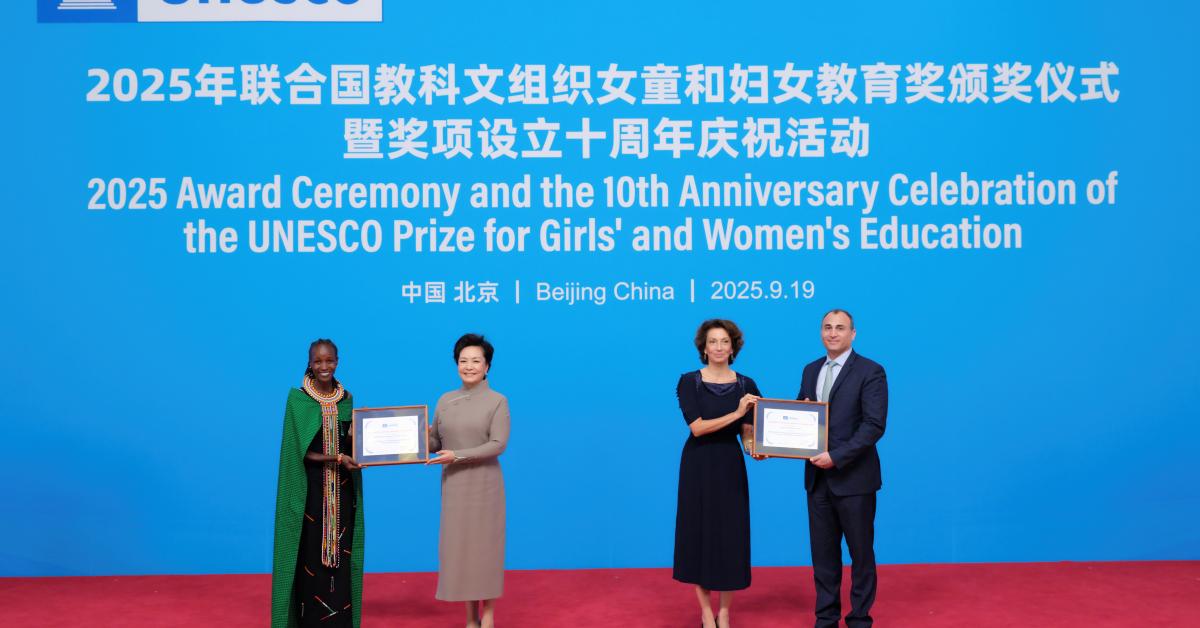
The UNESCO Prize for Girls’ and Women’s Education, established in 2015 with support from China, underscores UNESCO’s commitment to fostering gender equality and sustainable educational access for women. Over the past decade, the award has honored 20 laureates whose initiatives benefit millions of girls and women globally. Each laureate receives a grant of $50,000 to further their educational efforts.
This year, notable initiatives from Kenya and Lebanon were recognized. The Kenyan initiative focuses on educating Maasai girls by offering scholarships and addressing cultural barriers such as child marriage. Through advocacy and community engagement, more than 3,000 Maasai girls have completed their schooling and transitioned to higher education, nurturing future leaders in gender equality.
Meanwhile, a Lebanese initiative founded by two young women aids girls in acquiring technology, coding, and leadership skills in Lebanon and the wider Arab region. This program, driven by volunteers, provides free training and mentorship, benefiting over 2,500 girls across nine countries, particularly those in disadvantaged and refugee communities.
