


By Devayani Sathyan and Veronica Dudei Maia Khongwir
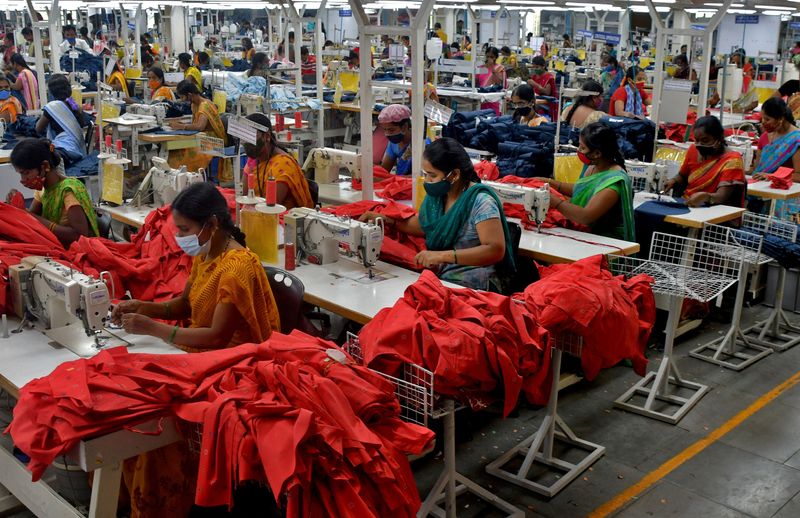
BENGALURU (Reuters) – A recent Reuters poll reveals that Indian women’s participation in the workforce will take at least two decades to align with their G20 counterparts. Experts have pointed out that a significant amount of this participation is in poorly-paid self-employment, contributing to India’s already low participation rate.
Job creation in India is failing to meet the demands of its rapidly growing, predominantly young population. Women represent half of this workforce, yet many are not engaged in formal employment, with most lacking job security.
The latest data from the 2023-24 Periodic Labour Force Survey (PLFS) indicates an increase in the female labour force participation rate (FLFPR) to 31.7%, up from 27.8%. However, this figure is significantly short of Prime Minister Narendra Modi’s ambitious goal of reaching 70% by 2047, aiming to match levels seen in more advanced economies.
According to World Bank statistics, India has the lowest FLFPR among G20 nations, trailing behind Saudi Arabia, Turkey, and even neighboring countries like Bangladesh and Bhutan. The G20 average hovers around 50%.
In the recent survey, around 80% of leading economists and policy analysts—32 out of 40—estimated that it could take 20 to 30 years for India’s FLFPR to match that of other G20 nations. In fact, 18 of those respondents indicated that this process might extend beyond three decades, while only eight believed it could happen within the next 10-20 years.
Ashwini Deshpande, a professor and head of the economics department at Ashoka University, commented on the nature of women’s work in India, stating, “The kind of work women are involved in is not really what we call good jobs or good quality work. It’s really just bottom of the ladder, survivalist kind.” She emphasized that while participation is encouraging, it lacks the transformative impact that is typically expected.
Deshpande further noted that the job crisis in India is more severe than in similar GDP nations, adding, “And when jobs are scarce, men get the first priority everywhere.” Currently, only 15.9% of working women secure regular wage or salaried positions that include contracts, stable pay, or any form of benefits.
Despite an uptick in FLFPR, the PLFS data revealed that approximately 73.5% of rural working women and over 40% of women in urban areas are primarily self-employed. This raised concerns among experts, with more than 70% (32 of 43) doubting the accuracy of the official data, indicating it conceals the true extent of the employment crisis.
Rosa Abraham, assistant professor at Azim Premji University, expressed concerns about the correlation between women’s employment and household earnings, stating, “Ideally…you should see household earnings also go up when women are participating and that has not happened, which is a very big marker that this is potentially not the best kind of employment.”
Over 70% of those surveyed also highlighted that safety concerns and unpaid domestic responsibilities hinder many women from seeking employment. Women are reported to spend nearly five hours daily on household chores, which is more than three times the time men dedicate to similar tasks, according to the 2025 Time Use Survey.
Sangeeta Shroff, former professor at the Gokhale Institute of Politics and Economics, noted that the overlap of productive and reproductive responsibilities for women limits their employment options. She asserted, “To address such issues, it will require aggressive policy intervention which will require considerable time and resources.”
When it comes to solutions, respondents of the poll emphasized the need for expanded childcare resources, safer workplaces, and stronger anti-discrimination policies. Bina Agarwal, a professor of development economics and environment at the University of Manchester, highlighted the necessity for safe accommodations in urban areas, reliable transport for women, and the enforcement of laws against workplace harassment. “These are among many ideas feminist economists in India have been advocating for years. Is anyone listening?” Agarwal questioned.
