


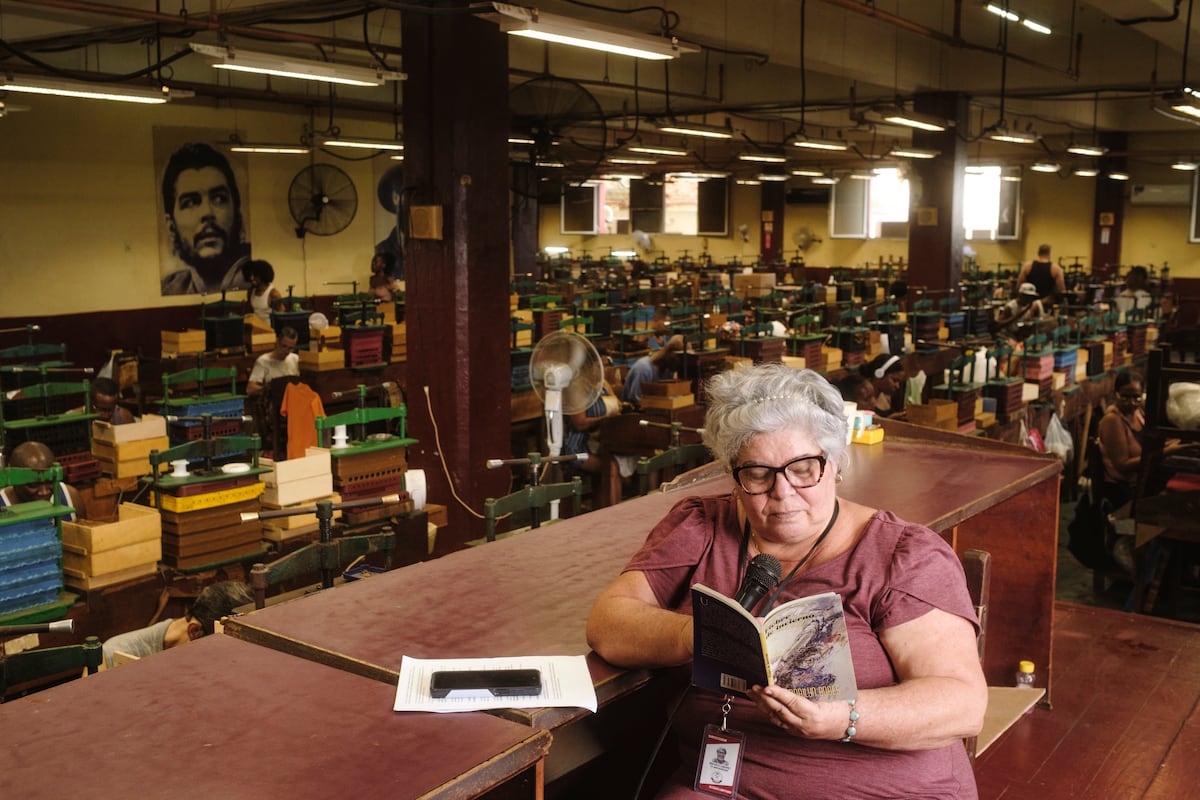
At the heart of Havana, Felicia Alejandra Torres Rodríguez has taken on a unique role at the Partagás Tobacco Factory. As the cigar reader, or “lectora,” she enhances the experience of cigar rollers during their labor hours, bringing literature and culture into their workspace. Each weekday at 11:00 a.m., she captivates her audience with selections from renowned Cuban authors and singers, turning the factory into a place of shared knowledge and enjoyment.
“You will be, like green tobacco in the sea, a slumber of life in the burning and beloved land of God,” she resonates, quoting a line from composer Eliseo Grenet’s song as the workers prepare for their shifts. Surrounded by the iconic imagery of Che Guevara, Torres balances her role as a reader along with her responsibilities as a novelist, taking her audience on a journey through poetry and stories, making their arduous work more bearable.
Torres, who transitioned to this profession five years ago from watchmaking, embraced the opportunity when the previous reader stepped down due to pandemic concerns. After a competitive 21-day selection process involving readings during three daily shifts, she was chosen to engage the rollers with her voice—a testament to her ability to connect with the workers, even if she humorously admits to playing a few favorite songs to win them over.
“When I arrived, I didn’t know anyone,” she recalls with a smile. “But I bent the rules a bit to sway their votes!” The Spanish-speaking workers’ choice that day reverberated loudly as they clacked their chavetas, signaling their approval for her reading style.
In a recent session, Torres celebrated the contributions of cigar rollers, highlighting their essential role within Cuban culture. “Tobacco and sugar are foundational to our national identity,” she explained. Cuba’s tobacco industry is a significant force, exporting between 70 and 80 million cigars each year, and such discussions foster a rich connection among workers.
Questions on various topics—from historical debates about the Romans or Egyptians to inquiries about current events or personal concerns—flow freely among the rollers, who often rely on Torres for information and advice. With a workforce heavily composed of women, this engagement fosters a unique camaraderie. “They ask a lot about sex,” she chuckles. “I have to keep learning every day; sometimes, I’ll say I don’t know, but I promise to find out!”
The origins of this trade date back to December 21, 1865, when the first readers enlivened the work environment at the same factory. Historian Zoe Nocedo notes how readers evolved from mere entertainers into educators, with their voices becoming a vital source of news and cultural exchange in local communities. “People used to gather at the windows to hear about current events,” she shared, indicating how cigar factories became hubs of literacy and information distribution.
The cigar rolling profession, with its intricate history tied directly to national struggles and cultural identity, has seen the integration of social education through periodic readings. “Without reading, there’s no cigar,” Nocedo emphasizes, further illustrating the depth of this practice. Support for independence movements, notably connected to José Martí, has historically stemmed from these educated workers, who understand their pivotal role in shaping Cuban society.
Within the bustling environment of La Corona Tobacco Factory, 100 skilled workers meticulously roll thin Cohiba cigars, each commanding a premium price abroad. Amidst the labor, individual experiences intertwine as employees share their lives, with the sound of the rolls echoing alongside the enriching literature offered by readers like Odalys Lara Reyes, who has dedicated decades to this craft. “She’s like a special teacher,” a worker observes, highlighting the impact readers have on the roller community.
Despite challenges posed by national power outages, these traditions continue to thrive. “We don’t want this legacy to fade,” Torres insists, underscoring the significance of continuity in their practice. Lara, the oldest reader, who has served for over 30 years, reflects on the emotional bonds formed through reading and communal engagement. “This factory is a family,” she says, recognizing the profound connections formed through shared stories and experiences.
The longstanding practice of reading to cigar rollers has endured through transformations in media consumption, remaining alive as a cultural cornerstone. Torres summarizes the sentiment perfectly: “The radio can’t answer questions about life. We are more than just voices; we are an integral part of their community.”
