


Caltech Breaks Ground with Gender Parity in STEM
Empowering Future Scientists
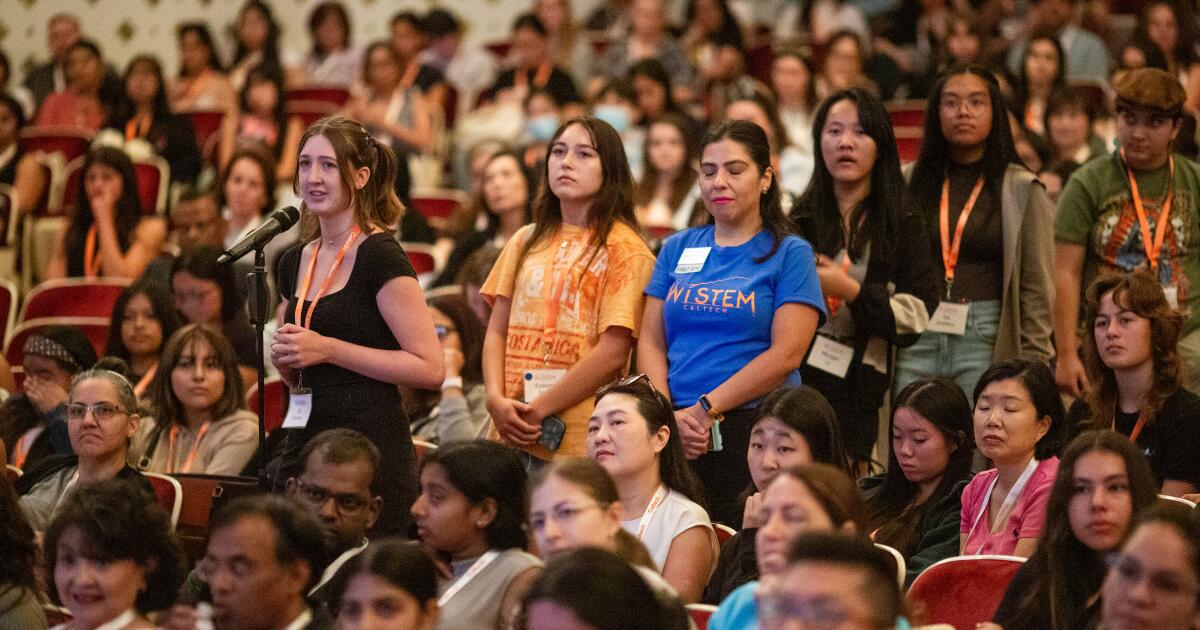
The auditorium was filled to capacity with high school girls from around the country, eagerly anticipating inspiration from a prominent figure in science. This exciting moment featured Katie Bouman, an associate professor at Caltech, who is renowned for her role in capturing the first-ever image of a black hole. In 2022, she co-led a groundbreaking team of over 300 researchers to photograph the supermassive black hole at the Milky Way’s center.
A Landmark Event for Women
Bouman’s lecture, part of the Caltech Women in STEM program, aimed to motivate young women by showcasing a successful female scientist. This initiative comes at a crucial time for Caltech, as for the first time in its 133-year history, more than half of the incoming undergraduate class will be women. This milestone celebrates the admission of 113 women alongside 109 men, fifty years after the institution welcomed its first female undergraduates in 1970.
The Significance of Representation
“What this means for young women is that we are a place that can be representative of them and their experiences,” said Ashley Pallie, Dean of Admissions at Caltech. The institute emphasizes its commitment to fostering an environment where women can thrive in science and engineering fields, which have historically been male-dominated.
Advancements in Gender Parity
Gloria L. Blackwell, the chief executive of the American Association of University Women (AAUW), praised Caltech’s achievement, noting that despite women earning about 60% of biology degrees, their representation in fields such as computer science and engineering remains low—around 18% and 20%, respectively.
Research indicates that societal biases often suggest that boys outperform girls in math and science, discouraging many young girls, particularly those from underrepresented communities, from pursuing STEM careers.
Legacy and Current Climate
Caltech is not the only educational institution striving for gender equality; Harvey Mudd College took significant steps in this direction, achieving a majority of female enrollment in engineering in 2014. Similarly, UC Berkeley reports nearly half of its students in STEM disciplines identify as female or nonbinary.
A Historical Perspective
Caltech’s journey toward gender parity began in 1970, when women were first admitted amid the broader push for gender equality. Louise Kirkbride, one of the first female students, faced a challenging environment but went on to have a successful career in venture capital and serves as a trustee at the institute. Her experience illustrates both the obstacles and the progress women have made since.
Inspiring the Next Generation
During her address, Bouman strived to show the importance of female representation in the sciences. After her lecture, a student expressed her admiration, stating, “You’re my dream scientist!” Such interactions demonstrate the impact of role models on young women’s aspirations.
The Women in STEM program has expanded to accommodate 500 high school girls, offering them a chance to connect with cutting-edge research and explore their interests in the fields of science and engineering.
Challenges Ahead
Despite progress in education, women face significant challenges in the workforce, holding around 45% of STEM degrees while constituting only 28% of the workforce in these areas. Cultural barriers, gender discrimination, and the need for supportive environments remain pressing issues.
Student Experiences
Students like Leah Cevallos, who feels empowered by the visibility of women in STEM, and Veronika Voss, who comes from a background with limited resources but has shown resilience through self-study, are prime examples of the talent that can flourish when given opportunities. Voss detailed her excitement about community and passion she witnessed during her visit to Caltech, saying, “I was like, oh my gosh, it is a real place and there are so many women here.”
