


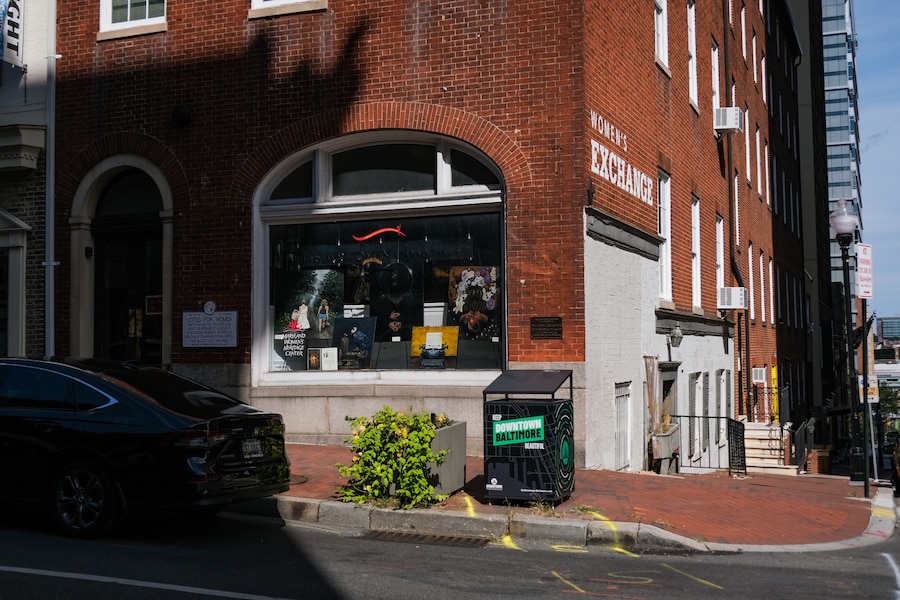
The Maryland Women’s Heritage Center, a nonprofit dedicated to preserving the history and contributions of women, is set to dissolve due to a lack of funding and challenges in attracting volunteers, according to executive director Diana Bailey.
Located at 333 N. Charles St., the center shared a building with the former Woman’s Industrial Exchange, a historic venue where women sold handmade goods and baked delights in the late 19th century. The center claims to embody the unique stories of Maryland women, serving as the nation’s first comprehensive state center of its kind.
Founded to honor the contributions of women throughout history, the center’s operational struggles mirror the plight of the industrial exchange, which shuttered permanently in 2020 after enduring prolonged financial difficulties. Following this closure, the building was acquired by Marian House, a nonprofit focused on providing rehabilitative support and housing for women and families. The Maryland Women’s Heritage Center moved into the space in the same year.
Katie Allston, CEO of Marian House, noted that the heritage center was a valuable tenant, sharing a mission that respected the building’s rich history. “It was a perfect match,” she stated, highlighting the center’s deep commitment to both the building and its historical significance.
A Challenging Path Forward
Having served as executive director for around 15 years, Bailey expressed the difficulties faced by the organization despite its dedicated staff. The center depended heavily on grants and donations, but funding has dwindled over the years, especially since state support ceased decades ago.
Bailey shared that, while a significant donation in 2020 enabled the center to support virtual programming and a scholarship, the increasing cost of rent eventually became unmanageable. With the lease expiration approaching in December, the board ultimately made the tough decision to cease operations.
Amid the challenges, Bailey expressed pride in the center’s achievements, including securing 10 suffrage markers for Maryland through the William G. Pomeroy Foundation, emphasizing the rigorous research that went into their establishment. “Those markers, they’re not going anywhere,” she affirmed.
As the center prepares to vacate its premises by December, it is also organizing a commemorative event in October. Bailey anticipates that the center will officially be dissolved by February or March. However, she aims to continue the work by partnering with the Community Foundation of Howard County to establish small grants for women’s history research and to maintain scholarship programs, along with potentially instituting a new women’s history award through Maryland Humanities.
Emphasizing the relevance of women’s history, Bailey calls on the public to actively engage in preserving these narratives, expressing concern that they might be overshadowed. This resonates particularly in light of current political climates that have drawn criticism for undermining women’s rights and diversity initiatives. She stated, “Women’s history is not just in March — it’s every day and especially these days.” Bailey believes this visibility is crucial for shaping young people’s perspectives in their communities.
This article was contributed to by Banner reporter Lee O. Sanderlin.
