


Getty Images
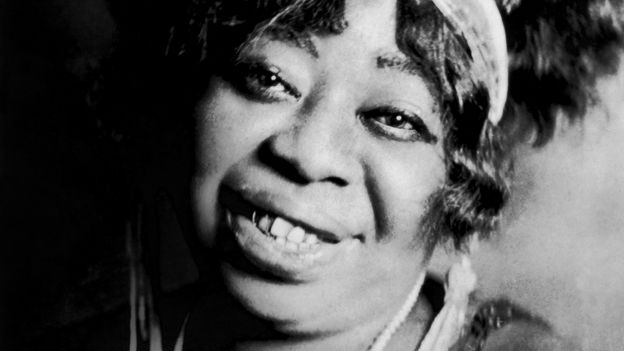
Cited as a pioneering work in the representation of black queer culture, Ma Rainey’s “Prove It on Me Blues” is a significant song that has left an indelible mark on music history.
In 1925, a police raid disrupted a gathering in a Chicago apartment where attendees were exclusively women, a stark deviation from typical speakeasy scenes common during Prohibition. Ma Rainey, known as the “Mother of the Blues,” was arrested but instead of concealing the incident, she transformed it into a bold musical statement with the release of “Prove It on Me Blues” in 1928.
The song’s lyrics make a powerful declaration of identity: “They say I do it, ain’t nobody caught me / Sure got to prove it on me; / Went out last night with a crowd of my friends, / They must’ve been women, ’cause I don’t like no men…”
With its clear message in the second verse, “I want the whole world to know,” Rainey’s anthem is recognized as one of the earliest declarations of queer identity in music. Dr. Cookie Woolner, an historian at the University of Memphis, asserts that the song resonated with many black women of the time, validating their experiences and desires.
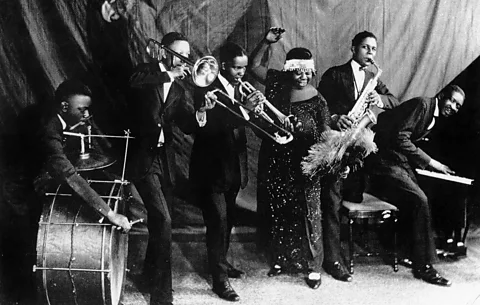
Born Gertrude Pridgett in 1886, Ma Rainey adopted her stage name from her husband, “Pa” Rainey, with whom she performed in a vaudeville act. Following their separation in 1916, she embraced a solo career blending traditional vaudeville styles with the rhythms of Southern blues. Rainey’s influence grew significantly when she joined Paramount Records in 1923, producing over 100 recordings, including her notable hit, “Ma Rainey’s Black Bottom” (1927).
Getty Images
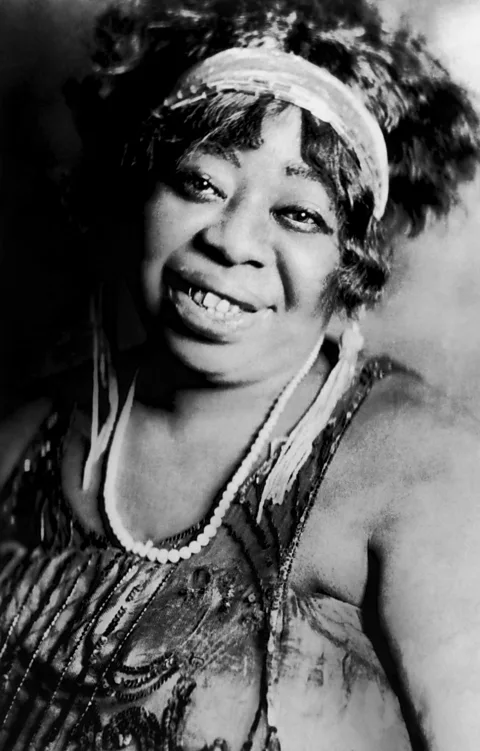
Rainey was part of a larger counterculture of lesbian blues artists in Harlem, including figures such as Gladys Bentley, Bessie Smith, Ethel Waters, and Alberta Hunter. This underground scene flourished in speakeasies and hidden venues known as “buffet flats,” where entertainment occurred away from mainstream scrutiny. Bessie Smith even captured this clandestine atmosphere in her song “Soft Pedal Blues” in 1925.
Operating within a framework of white management, Rainey performed for diverse audiences, enabling black queer culture to reach a broader segment of American society. However, this exposure also raised concerns about the commodification of black culture, as observed by sociologist W.E.B. Du Bois in 1927.
A Legacy of White Oppression
The blues genre emerged from the experiences of the descendants of enslaved individuals, intertwining themes of survival and resistance deeply rooted in personal narratives. Dr. Woolner notes that the blues allowed female artists to explore unspoken topics like sexuality and queerness.
The Great Migration further influenced this music, providing black women the liberty to pursue their desires in environments less controlled by societal norms.

Getty Images
The “hokum blues” genre epitomized this newfound freedom, openly celebrating female sexual empowerment. For instance, songs like Ida Cox’s “One Hour Mama” advocate for satisfaction in romantic relationships, while Ethel Waters’ “My Handy Man” conveys explicit innuendo.
These artists challenged traditional gender roles, as exemplified in Bessie Smith’s “Safety Mama” (1931), proposing a turn of the tables, suggesting that a “no-good man” should take on domestic duties.
Rainey showcased her financial independence through her extravagant style, often adorned with jewelry and bold outfits that defied traditional gender expectations. Her promotional materials for “Prove It on Me Blues” featured imagery that highlighted her confidence and allure.
Alamy
Rainey and her contemporaries brought unique female perspectives to blues music, addressing themes like infidelity and domestic violence. In “Black Eye Blues” (1928), a woman’s narrative of strength and resilience unfolds, while other songs, such as “Tain’t Nobody’s Bizness if I Do,” celebrate personal autonomy.
A Bold and Transgressive Message
Scholars like Sandra Lieb and Angela Davis have underscored the significance of female blues artists in shaping American culture, challenging the often male-centric historical narratives surrounding the genre. Woolner points out that female performers drew influences from various entertainment forms yet faced underappreciation.
“Prove It on Me Blues” stands as a paramount anthem within this subversive scene, foreshadowing the lesbian cultural movements of the following decades. It is a song that encapsulated the possibilities of gender nonconformity and same-sex love, resonating across generations.
Woolner emphasizes the unique landscape of 1920s America, stating, “Few other sites in 1920s American culture allowed for such bold messages about gender transgression and same-sex desire as Prove It on Me Blues.” Rainey’s recognition of music’s emotional impact illustrates her understanding of its importance in fostering community and connection.
